
Bahamas Pig Beach + Diving
5DFrom ₹1,95,000
A 5-day luxury route to the Grand Canyon's South Rim from Tusayan.
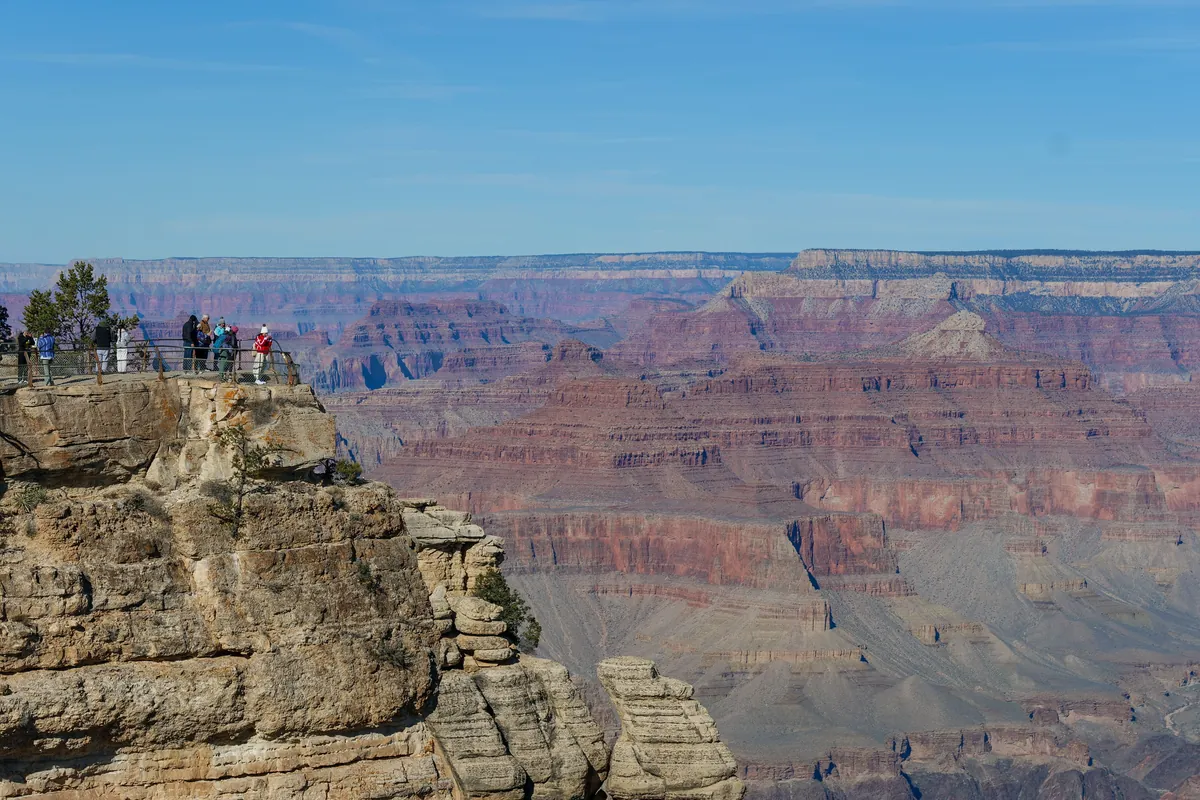
The week centres on the Grand Canyon, a steep-sided gorge cut by the Colorado River in Arizona that runs 277 miles long, up to 18 miles wide and over a mile deep, exposing nearly two billion years of Earth's geological history in its layered walls as the river cut down while the Colorado Plateau was slowly uplifted. Ancestral Puebloan communities, centred on the present-day Four Corners area, were the first people known to live in the canyon, with occupation reaching back as early as 1200 BCE by current archaeological consensus. Spanish soldiers under Captain García López de Cárdenas reached the South Rim in September 1540 while searching for the fabled Seven Cities of Cibola, and reported rock formations 'bigger than the great tower of Seville'; no other Europeans are recorded visiting for more than two centuries afterward. President Theodore Roosevelt, an avid outdoorsman, visited repeatedly from 1903, established a game preserve in 1906 and used the new Antiquities Act to declare the canyon a national monument in 1908, over the objections of mining claim holders who delayed full national park status for another eleven years until 1919.
On the South Rim, more than 20 miles east of the main visitor area at Grand Canyon Village, stands the Desert View Watchtower, a 70-foot stone structure completed in 1932 to a design by the architect Mary Colter, who spent six months studying ancestral Puebloan and Hovenweep watchtower prototypes before building a clay model of the site. Though styled to resemble an ancient Puebloan tower, its scale dwarfs any known original; engineering for the structure was provided by the Atchison, Topeka and Santa Fe Railway, and its interior murals were painted by the Hopi artist Fred Kabotie. Its upper floors now serve as an observation deck over the eastern stretch of the canyon.
The Bright Angel Trail descends 4,380 feet from Grand Canyon Village to the Colorado River, its upper section originally built by the Havasupai people to reach the perennial water source now known as Havasupai Gardens, where the tribe settled seasonally until being forced out by the National Park Service by 1928. Ralph H. Cameron, who later served as a U.S. senator for Arizona, improved the trail from 1890, extended it to the river, and charged tolls for its use and for water and outhouse access along the way — a monopoly that spurred the Santa Fe Railway to build the competing Hermit Trail in 1911 and the Park Service to build the South Kaibab Trail in 1924, before Bright Angel itself passed into Park Service control in 1928. Today it is maintained as a corridor trail with resthouses supplied by a trans-canyon pipeline, and it remains the principal route hikers and mules use to reach Phantom Ranch at the canyon floor.
Farther from the main rim, on Havasupai tribal land, Havasu Falls drops over a 90-to-100-foot travertine cliff on Havasu Creek into a series of plunge pools; a high concentration of dissolved calcium carbonate in the water gives it a vivid blue-green colour and builds the natural travertine dams found near the falls. The falls' shape has shifted repeatedly after flash floods — before 1910 the water fell as a near-continuous sheet known as Bridal Veil Falls, and the single-chute notch seen today first opened that year.
Across the week, the route moves from rim to trail to inner canyon: the two-billion-year rock record of the Grand Canyon itself, the watchtower built to frame its scale from the South Rim, the Bright Angel Trail that carries hikers down through those same layers along a route the Havasupai cut first, and Havasu Falls where the canyon's dissolved limestone turns the creek an unmistakable turquoise. Each stop reads a different chapter of the same carved landscape and the people, from Ancestral Puebloan to Havasupai to National Park Service, who have shaped access to it.
Text adapted from the linked articles under CC BY-SA 4.0; edited for length.
Every dimension the Taro team tags this pack with — filter by any of these on the packs page.
Share your travel month, group size, budget comfort, and must-do experiences. The Taro team will shape the right route before any payment conversation.