Bahamas Pig Beach + Diving
5DFrom ₹1,95,000
A 6-day premium route through Mexico City, featuring Templo Mayor, Frida Kahlo Museum, Teotihuacan and Xochimilco.
Mexico City Historic Centre opens at the Templo Mayor, the main temple of the Mexica people in their capital Tenochtitlan, called Huēyi Teōcalli — "great house of god" — in Nahuatl and dedicated simultaneously to Huitzilopochtli, god of war, and Tlaloc, god of rain and agriculture, each with its own shrine and staircase atop the pyramid. Construction began after 1325 and the temple was rebuilt six times, reaching roughly 100 by 80 metres at its base and dominating the city's Sacred Precinct, before the Spanish destroyed it almost entirely in 1521 and built the Mexico City Metropolitan Cathedral over the site. Its location was lost for centuries until 20th-century excavations — beginning with Manuel Gamio's discovery of its southwest corner and culminating in a major dig launched after electrical workers struck a monolith in 1978 — recovered all but the first of its seven building phases, along with the circular stone of Coyolxauhqui and the serpent-flanked platforms of the fourth temple, built under Moctezuma I.
The route continues to the Frida Kahlo Museum, known as La Casa Azul for its cobalt-blue walls, in the Colonia del Carmen neighbourhood of Coyoacán — the house where the artist was born in 1907, lived for years with her husband Diego Rivera, and died in an upstairs room; Rivera donated the building and its contents in 1957 to establish it as a museum in her honour. Built in 1904 around a central courtyard and originally finished with French-style detailing later replaced by a plainer façade, the house preserves ten rooms much as they looked in the early 1950s, holding Kahlo's own art collection, Mexican folk art, pre-Hispanic artifacts and personal mementos alongside works by Rivera, José María Velasco and Paul Klee; today it draws around 25,000 visitors a month, making it one of the city's most visited museums.
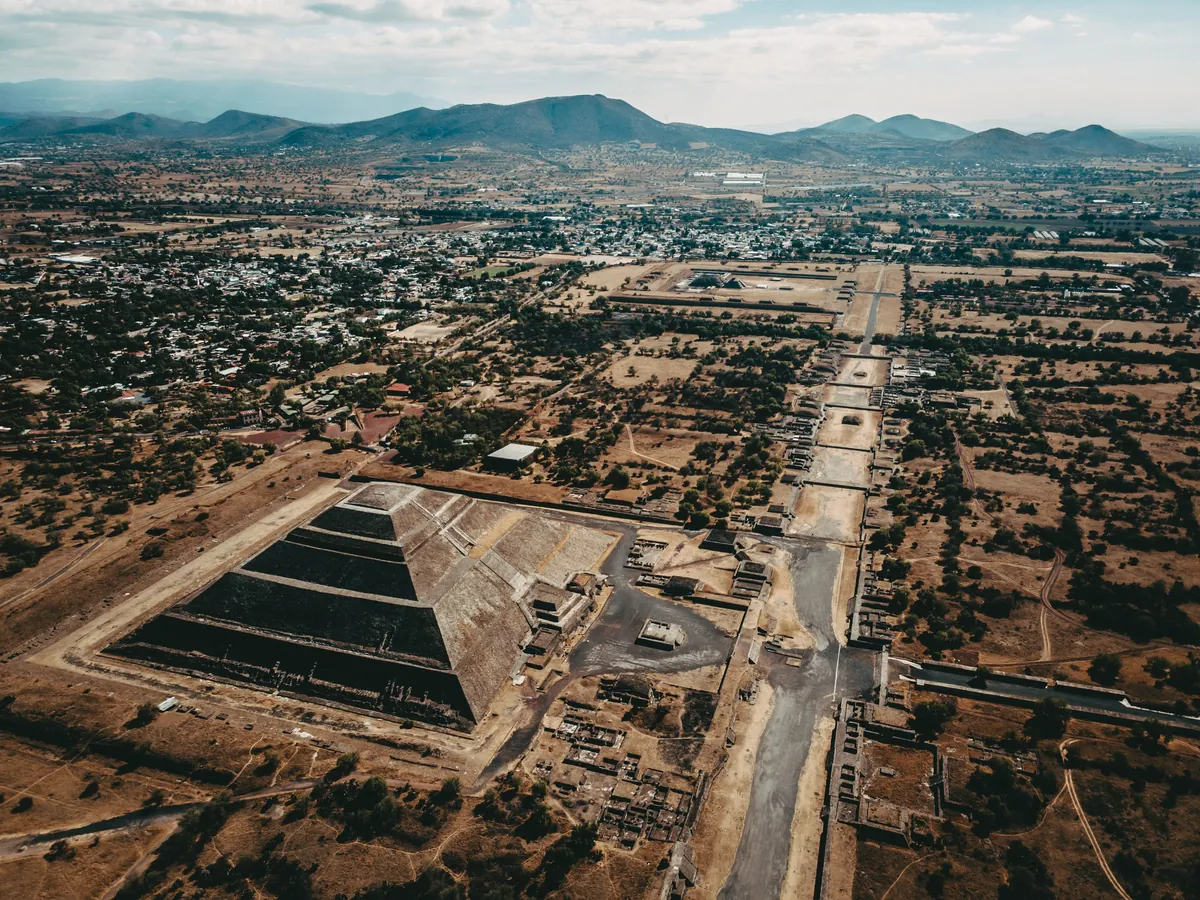
Outside the city proper, Teotihuacan lies 40 kilometres northeast in a sub-valley of the Valley of Mexico, an ancient Mesoamerican metropolis that predates the Aztec Empire by centuries and was already in ruins by the time the Mexica named it — Teōtīhuacān, "birthplace of the gods" — and adopted it into their own creation myths. At its height around 450 CE the city covered more than 30 square kilometres and may have held a population approaching 100,000, organised into multi-family residential compounds along the Avenue of the Dead and centred on the Pyramid of the Sun and Pyramid of the Moon, among the most architecturally significant structures raised anywhere in the pre-Columbian Americas; the city also exported fine obsidian tools traded throughout Mesoamerica before its decline, beginning around the sixth century, amid drought and the burning of its major civic buildings.
The route closes at Xochimilco, a borough in the city's southeast built around the formerly independent settlement of the same name on what was once the southern shore of Lake Xochimilco. Its network of roughly 170 kilometres of canals and chinampas — artificial agricultural islands built up over centuries on rafts of juniper branches and lakebed mud, a technique invented locally around a thousand years ago to expand food production for the Aztec Empire — is the last surviving remnant of the vast lake-and-canal system that once linked most of the settlements across the Valley of Mexico, and the reason the area was inscribed as a World Heritage Site. Visitors and city residents alike still travel the canals aboard trajineras, colourful flat-bottomed boats, past around 200 chinampas still farmed in the borough's centre, closing a six-day route from an Aztec temple's rubble to the floating gardens their descendants still tend.
Text adapted from the linked articles under CC BY-SA 4.0; edited for length.
Every dimension the Taro team tags this pack with — filter by any of these on the packs page.
Share your travel month, group size, budget comfort, and must-do experiences. The Taro team will shape the right route before any payment conversation.