Costa Rica Rainforest + Beaches
8DFrom ₹1,85,000
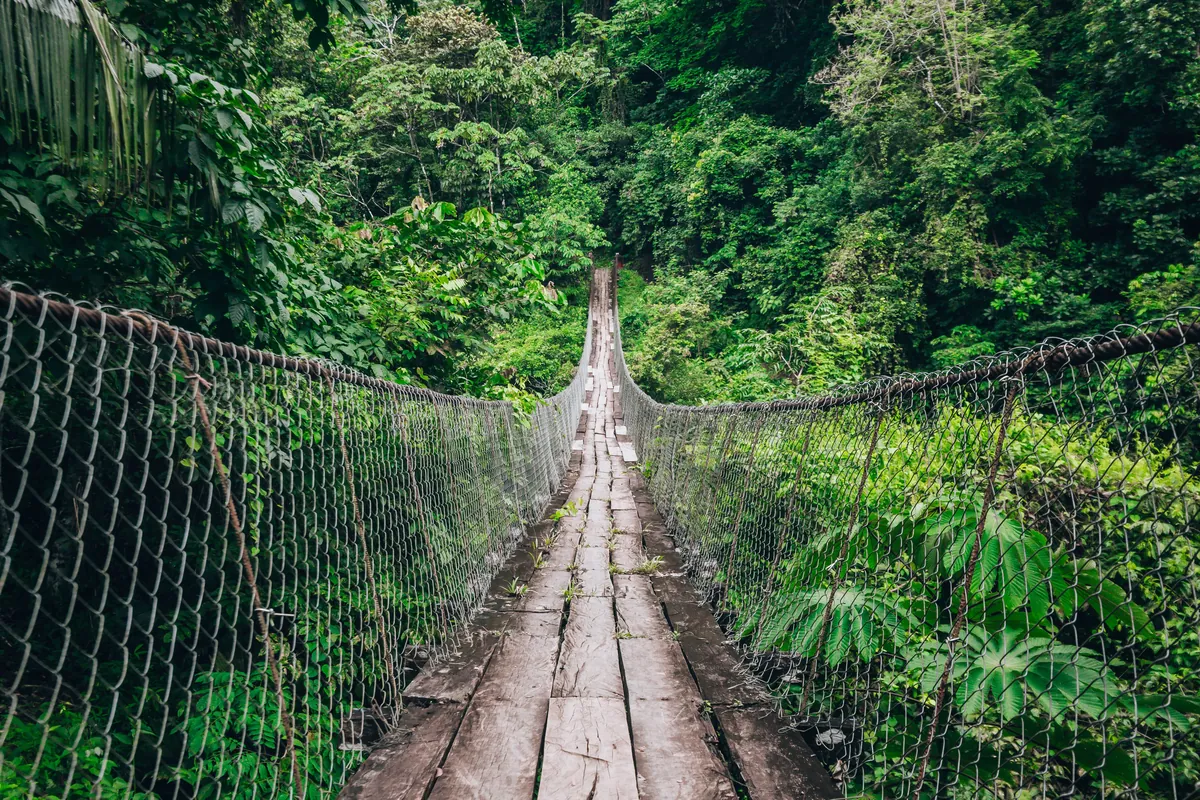
A 6-day premium route through Monteverde's cloud forest reserves and canopy walkways.
Monteverde Cloud Forest Canopy opens in the Monteverde Cloud Forest Reserve, founded in 1972 along the Cordillera de Tilarán and now covering more than 10,500 hectares of cloud forest across six life zones, ninety percent of it virgin. The reserve traces its origins to a community of Quaker families from Alabama who settled the area in 1951 to farm and to avoid the Korean War draft, naming their new home Monteverde — "Green Mountain" — for its year-round foliage; they chose Costa Rica in part because the country had abolished its army only three years earlier. Visiting biologists in the late 1960s, including Joseph Tosi and Leslie Holdridge of the Tropical Science Center, recommended the community preserve its surrounding forest to protect its water supply and act as a windbreak for its fields, and in 1972 graduate student George Powell, struck by the area's biodiversity and troubled by hunting and land clearing nearby, used his own funds to buy out squatters and secured a symbolic one-colón donation of 328 hectares from the Guacimal Land Company to found the reserve that year.
The reserve holds more than 2,500 plant species — more orchid species than anywhere else recorded — alongside 100 mammal species, 400 bird species and 120 species of reptile and amphibian, though its best-known resident, the golden toad, was declared extinct in 1989 after a fungal disease wiped out roughly 40% of Monteverde's amphibian population. Its most sought-after bird is the resplendent quetzal, a trogon whose males carry iridescent green tail plumes that can reach a metre in length above a red lower breast, migrating seasonally between higher nesting elevations near the Continental Divide and lower forest on the Pacific slope; classified as near threatened, with an estimated global population of 20,000 to 50,000, the quetzal nests in hollowed-out decaying trees and feeds mainly on wild avocados and other fruit of the laurel family, regurgitating the pits and helping disperse the very trees it depends on.
A short distance from the reserve, near the village of Santa Elena, Selvatura Park is a nature centre within the same Cordillera de Tilarán cloud forest, holding a sloth habitat and butterfly gardens alongside its canopy walkways, and sits directly adjacent to the Monteverde Cloud Forest Reserve itself, drawing on the same misty, epiphyte-heavy forest that the reserve was created to protect.
The route closes at Arenal Volcano, a young andesitic stratovolcano roughly 90 kilometres northwest of San José that stands 1,633 metres high with a conical profile and, estimated at under 7,500 years old, ranks among the youngest in Costa Rica. Dormant for centuries beforehand, Arenal erupted unexpectedly on 29 July 1968, burying more than 15 square kilometres under rock, lava and ash and opening three new craters on its western flank; the eruption that began that day continued intermittently until 2010, making it, by duration, the tenth-longest volcanic eruption recorded anywhere since 1750, and the volcano — one of Costa Rica's seven historically active peaks — has been dormant since, its slopes now within Arenal Volcano National Park and its reservoir supplying hydroelectric power to the national grid.
Text adapted from the linked articles under CC BY-SA 4.0; edited for length.
Every dimension the Taro team tags this pack with — filter by any of these on the packs page.
Share your travel month, group size, budget comfort, and must-do experiences. The Taro team will shape the right route before any payment conversation.