Why Thailand Wellness works
Traditional Thai massage, known in Thai as nuat thai or nuat phaen boran, combines acupressure applied along energy lines called sen, principles drawn from Indian Ayurvedic medicine, and assisted yoga postures, and it was added to UNESCO's Representative List of the Intangible Cultural Heritage of Humanity in December 2019. Practitioners work without oils or lotions, and the recipient wears loose, lightweight clothing while the practitioner uses constant body contact to compress, pull, stretch, and rock the body rather than simply working the muscles; the concept of metta, or loving-kindness rooted in Buddhist teaching, is considered integral to the practice, and experienced practitioners emphasise their own meditation as part of how the technique is delivered.
The tradition's origins are woven into Thai religious and royal history. Its spirit intermediary is Jivaka Komarabhacca, described in the Pali Buddhist canon as personal physician to the Buddha and to the Indian King Bimbisara more than 2,500 years ago, and the oldest physical evidence of massage practice in Thailand is a stone inscription from the Sukhothai period, found at Wat Pa Mamuang, that depicts the cultivation of medicinal herbs alongside massage practice. By the Ayutthaya period, the Three Seals Law recorded an entire Department of Massage Physicians ranked above many other government departments, and during the reign of King Narai in the seventeenth century, court physicians compiled traditional remedies for conditions of the body's sen and lom, or vital energy lines, into what became known as Phra Narai's Materia Medica.
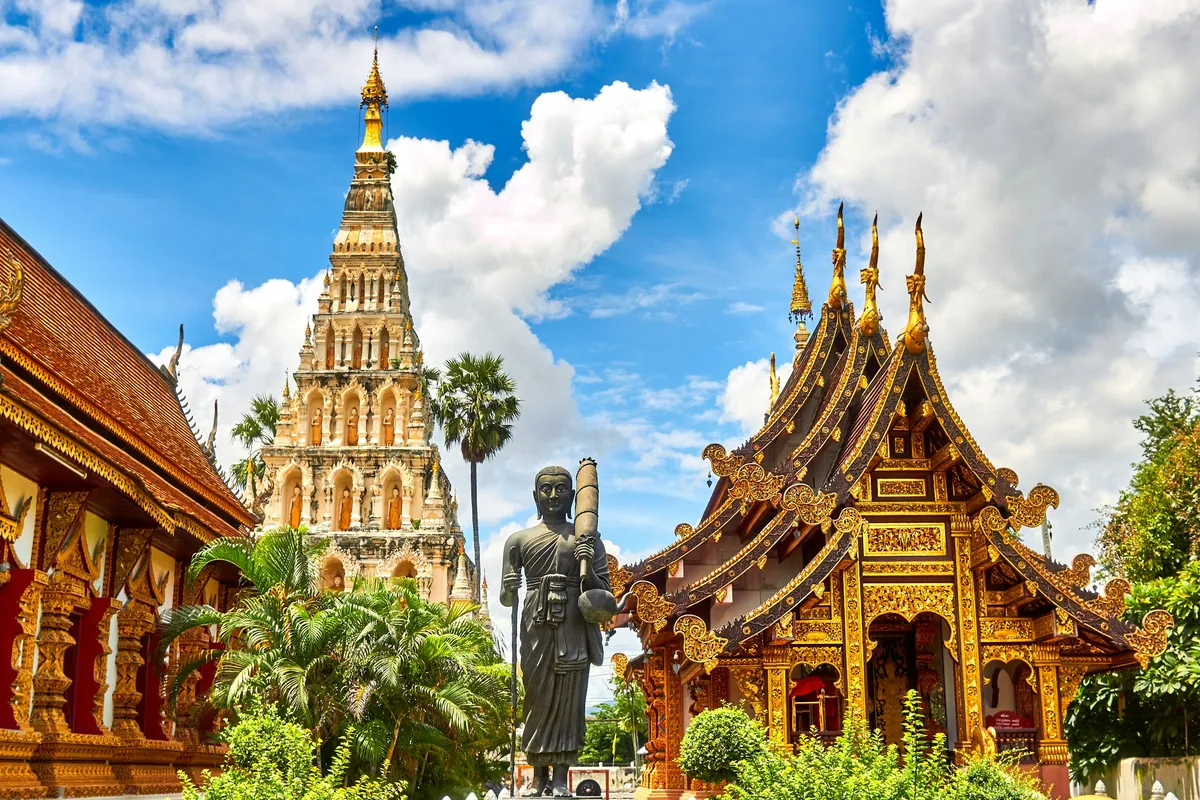
Chiang Mai, in Thailand's northern highlands, functions today as a hub for this wellness tradition alongside its role as the historic capital of the Lan Na kingdom, founded by King Mangrai in 1296. The city holds 117 Buddhist temples within its old moated centre, including Wat Chedi Luang, founded in 1401, and Wat Phra Singh, built in 1345 in classic Northern Thai style, and its Buddhist calendar includes the Vesak pilgrimage up Doi Suthep mountain, where thousands walk after sunset from the mountain's base to the temple of Wat Phra That Doi Suthep at its summit. Wat Rampoeng, near the Wat U-Mong forest temple on the city's western edge, houses the Northern Insight Meditation Center, where students of vipassana meditation traditionally stay for periods from ten days to more than a month, practising for extended hours each day under the temple's teaching lineage.
Muay Thai, sometimes called the Art of Eight Limbs for its combined use of fists, elbows, knees, and shins, is a full-contact striking art whose name descends from an earlier term, Ram Mut Ram Muay, used during the reign of King Rama II in the early nineteenth century. The word muay itself traces to a Sanskrit root meaning "to bind" or "to tie together," while Tai, the root of Thai, means "free," and the practice is documented in Northern Thai palm-leaf manuscripts going back to the Mangrai Law of 1296. A practitioner is known as a nak muay, and the sport's governing body in Thailand, the Professional Boxing Association of Thailand, oversees the professional league that has since carried Muay Thai into gyms and rings well beyond the country's borders.
Between the temple-based meditation tradition centred on Chiang Mai, the centuries-old massage discipline formally recognised by UNESCO, and a combat art with roots recorded in thirteenth-century manuscripts, Thailand's wellness practices are not a modern overlay on the country but a continuation of institutions — royal medical departments, monastic meditation centres, and martial traditions — that have operated in largely the same form for hundreds of years. Visitors moving between a Chiang Mai temple courtyard, a massage school tracing its lineage to the Ayutthaya court, and a Muay Thai gym are, in each case, stepping into a practice with its own documented history rather than a package assembled for tourism.
- Traditional Thai massage — Wikipedia, CC BY-SA 4.0
- Chiang Mai — Wikipedia, CC BY-SA 4.0
- Muay Thai — Wikipedia, CC BY-SA 4.0
Text adapted from the linked articles under CC BY-SA 4.0; edited for length.
Trip Snapshot
Highlights
Suitable For
Thailand Wellness, in frame
A quick visual sense of the landscapes, stays, and atmosphere your itinerary can be built around.
Build a Thailand Wellness itinerary around your dates.
Share your travel month, group size, budget comfort, and must-do experiences. The Taro team will shape the right route before any payment conversation.