Why Swiss Alps Honeymoon works
The Swiss Alps are the Alpine region of Switzerland, one of the country's three main physiographic regions alongside the Swiss Plateau and the Swiss Jura. They extend across both the Western Alps and the Eastern Alps, an area sometimes called the Central Alps, and cover 60 percent of Switzerland's total surface area of 41,285 square kilometres, making Switzerland one of the most mountainous countries in Europe. While the northern ranges, from the Bernese Alps to the Appenzell Alps, lie entirely within Switzerland, the southern ranges from the Mont Blanc massif to the Bernina massif are shared with neighbouring France, Italy, Austria, and Liechtenstein. Although Switzerland holds only 14 percent of the Alps' total area, 48 of the range's 82 four-thousand-metre peaks rise within Swiss territory, among them Dufourspitze at 4,634 metres, the Dom, the Liskamm, the Weisshorn, and the Matterhorn at 4,478 metres.
Since the Middle Ages, transit across the Alps has shaped the region's history, and the area north of the St Gotthard Pass became the nucleus of the Swiss Confederacy in the early fourteenth century. Alpine tourism itself began with the first ascents of the range's principal summits: the Jungfrau in 1811, Piz Bernina in 1850, Monte Rosa in 1855, the Matterhorn in 1856, the Dom in 1858, and the Weisshorn in 1861, most of them climbed by British mountaineers guided by local alpinists. Hotels and mountain huts followed in the mid-nineteenth century, along with the founding of the Swiss Alpine Club in 1863, and a wave of mountain railways opened in the following decades, including lines to the Rigi in 1873, Pilatus in 1889, and the Gornergrat in 1898. The Jungfraubahn, completed in 1912, still carries visitors to the Jungfraujoch, the highest railway station in Europe.
Today's visitor moves through this landscape largely on that same rail network, riding up to viewpoints and glacier stations built more than a century ago, and past resort villages that grew up around them. Zermatt and Saas-Fee sit beneath year-round summer ski areas, while car-free villages such as Riederalp, Bettmeralp, Grindelwald, Mürren, and Wengen are reached only by cable car or mountain train, a legacy of the terrain rather than a modern tourism policy. The Klein Matterhorn, above Zermatt, is the highest point on the European continent served by cable car, and the great north faces of the Eiger, the Matterhorn, and the Piz Badile remain landmarks for alpinists from around the world. The Swiss National Park in Graubünden, founded in 1914 as the first alpine national park, and the Jungfrau-Aletsch Protected Area, the first UNESCO World Heritage Site in the Alps, preserve stretches of this high country largely as they were found.
The Alps' climate divides sharply by altitude, falling by roughly 0.56 degrees Celsius for every 100 metres of elevation gained, which produces three distinct zones. The subalpine zone below the tree line holds nearly all human settlement and is covered mainly in conifer forest above 1,200 to 1,400 metres; the alpine zone above the tree line supports mountain grasses, wildflowers, and pastures up to the permafrost limit around 2,600 metres; and the glacial zone above that carries permanent snow and ice, feeding glaciers such as the Upper Grindelwald Glacier, which descends as low as 1,500 metres. The Swiss Alps' glaciers cover 1,220 square kilometres, representing 44 percent of all glaciated area in the Alps, though the region's ski season, running from as early as November to as late as May in most years, and its dense summer hiking network reflect the more temperate, human-scaled zones below the ice.
Switzerland maintains a network of well-marked trails totalling 62,000 kilometres, of which 23,000 kilometres wind through mountainous terrain, connecting valley towns to high alpine huts and viewpoints without requiring technical climbing. Winter visitors concentrate in Valais, the Bernese Oberland, and Graubünden, at resorts including Davos-Klosters, St. Moritz in the Engadin, Verbier, Crans-Montana, and the Aletsch Arena villages, most of which open for the season in December and run through April. Because many aerial tramways and cable cars built for winter sport operate year-round, hikers can reach high-altitude terrain in summer with little effort, extending the same infrastructure that carries skiers in January to carry walkers and honeymooners in July.
- Swiss Alps — Wikipedia, CC BY-SA 4.0
Text adapted from the linked articles under CC BY-SA 4.0; edited for length.
Trip Snapshot
Highlights
Suitable For
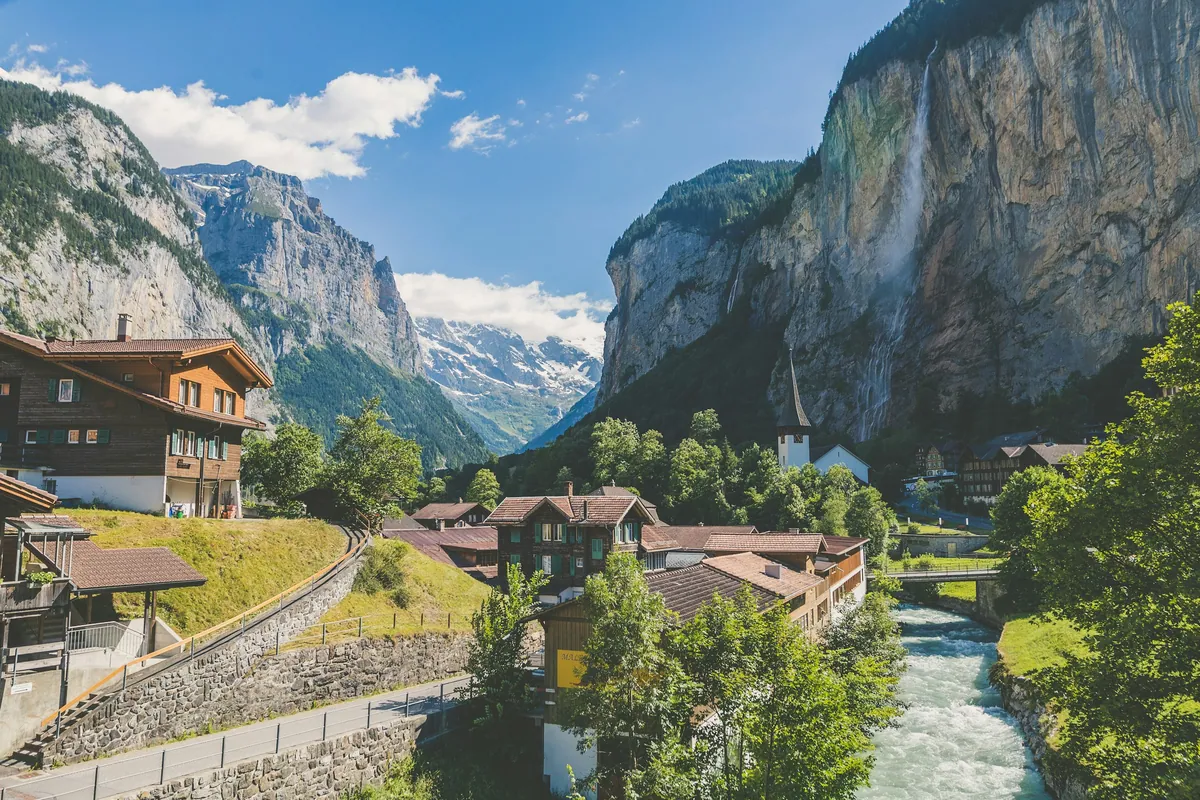
Swiss Alps Honeymoon, in frame
A quick visual sense of the landscapes, stays, and atmosphere your itinerary can be built around.
Build a Swiss Alps Honeymoon itinerary around your dates.
Share your travel month, group size, budget comfort, and must-do experiences. The Taro team will shape the right route before any payment conversation.