Why South Korea works
South Korea, officially the Republic of Korea, occupies the southern half of the Korean Peninsula in East Asia, bordering North Korea along the Korean Demilitarized Zone, with the Yellow Sea to the west and the Sea of Japan to the east. Its population of about 52 million includes roughly half living in the Seoul metropolitan area, the ninth most populous metropolitan area in the world, with Busan, Daegu, and Incheon as other major cities. The peninsula was inhabited as early as the Lower Paleolithic period, and its first kingdom appears in Chinese records from the early seventh century BC; the rival kingdoms of Goguryeo, Baekje, and Silla later consolidated from the mid-first century BC, with Silla unifying most of the peninsula in the late seventh century AD, followed by the lasting unification of the Goryeo dynasty from 918 to 1392 and the Joseon dynasty from 1392 to 1897, which produced major cultural, economic, and scientific achievements before adopting an isolationist policy from the mid-seventeenth century.
Geographically, the peninsula extends some 1,100 kilometres from the East Asian mainland, flanked by the Yellow Sea to the west and the Sea of Japan to the east, with its southern tip on the Korea Strait and East China Sea; South Korea's total area is 100,472.4 square kilometres. The country divides into four general regions: a mountainous east with narrow coastal plains, a western region of broad coastal plains and rolling hills, a mountainous southwest, and a southeast dominated by the Nakdong River basin, with lowlands making up only about 30 percent of total land area. South Korea maintains 20 national parks and natural areas including the Boseong Tea Fields, Suncheon Bay Ecological Park, and Jirisan, alongside roughly 3,000 islands off its coast.
Traditional Korean architecture, shaped by a history of repeated construction and destruction, is built around harmony with nature: ancient architects used a bracket system with thatched roofs and heated floors called ondol, and upper-class households built larger homes with elegantly curved tiled roofs and lifting eaves. That tradition survives in palaces and temples, preserved old houses known as hanok, and sites such as Hahoe Folk Village, Yangdong Folk Village, and the Korean Folk Village, several of them UNESCO World Heritage Sites, while Western architectural styles arrived at the end of the nineteenth century and Japanese colonial rule from 1910 imposed its own modern architecture on the country before anti-Japanese sentiment and the Korean War destroyed much of what had been built during that period.
South Korea has a humid continental and humid subtropical climate shaped by the East Asian monsoon, with a short, heavy rainy season called jangma running from late June through July; Seoul's average January temperature ranges from −7 to 1°C and its August range from 22 to 30°C, with winters milder along the southern coast and colder in the mountainous interior, while summer can turn uncomfortably hot and humid, with temperatures exceeding 30°C across most of the country. The country experiences four distinct seasons, with spring from late March to early May, summer from mid-May to early September, autumn from mid-September to early November, and winter from mid-November to mid-March, and the southern coast is prone to late-summer typhoons bringing strong winds, heavy rain, and occasional flooding.
South Korean tourism has been driven in part by the global popularity of Korean pop culture, or Hallyu, including its music and television dramas, with more than 17 million foreign tourists visiting the country in 2019. Korean cuisine, hansik, has developed over centuries of social and political change, with ingredients and dishes varying by province and a former royal court cuisine that once brought regional specialties together for the royal family; meals are built around rice, noodles, tofu, vegetables, fish, and meat, accompanied by numerous banchan side dishes, with kimchi, a fermented and usually spicy vegetable dish, served at nearly every meal and counted among the country's best-known dishes.
- South Korea — Wikipedia, CC BY-SA 4.0
Text adapted from the linked articles under CC BY-SA 4.0; edited for length.
Trip Snapshot
Highlights
Suitable For
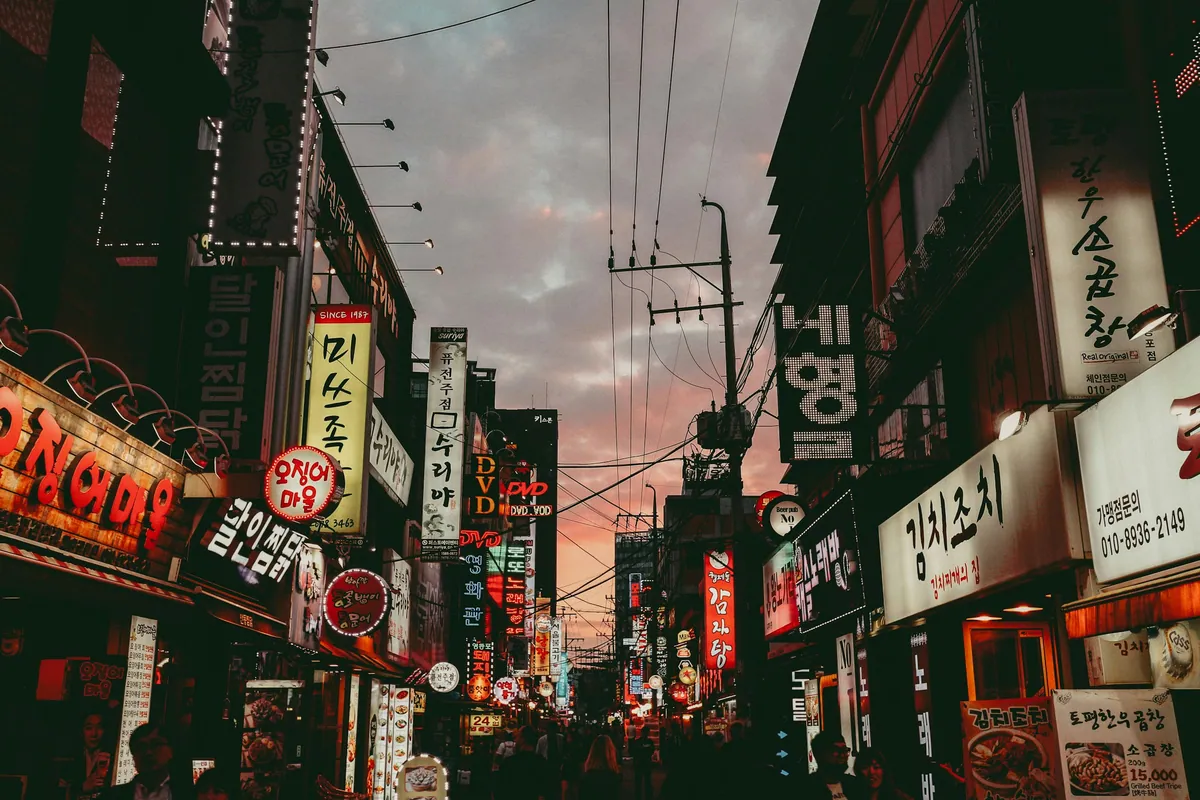
South Korea, in frame
A quick visual sense of the landscapes, stays, and atmosphere your itinerary can be built around.
Build a South Korea itinerary around your dates.
Share your travel month, group size, budget comfort, and must-do experiences. The Taro team will shape the right route before any payment conversation.