Why Santorini Honeymoon works
Santorini, officially Thira or Thera, is a Greek island in the southern Aegean Sea about 200 kilometres southeast of the mainland, the largest island in a small, circular archipelago shaped by the Santorini caldera and the southernmost member of the Cyclades group. The island covers about 73 square kilometres and had a 2021 census population of 15,480, while the wider municipality, which also includes Therasia and the uninhabited islands of Nea Kameni, Palaia Kameni, Aspronisi, Anydros, and Christiana, spans a total land area of 90 square kilometres. Santorini is the most active volcanic centre in the South Aegean Volcanic Arc, a roughly 500-kilometre-long belt where volcanism on Thera began around 2 million years ago.
About 3,600 years ago, at the height of the Minoan civilization, the island was the site of one of the largest volcanic eruptions in recorded history, an event that lasted weeks, caused massive tsunami waves, and left the large, water-filled caldera surrounded by deep volcanic ash deposits that defines Santorini's shape today; some have suggested the eruption as a source for the legend of Atlantis. Excavations beginning in 1967 under Spyridon Marinatos at the Akrotiri site uncovered a Minoan town entombed in solidified ash, with complexes of multi-level buildings, streets, and squares, and walls still standing as high as eight metres, making Thera the best-known Minoan site outside Crete itself.
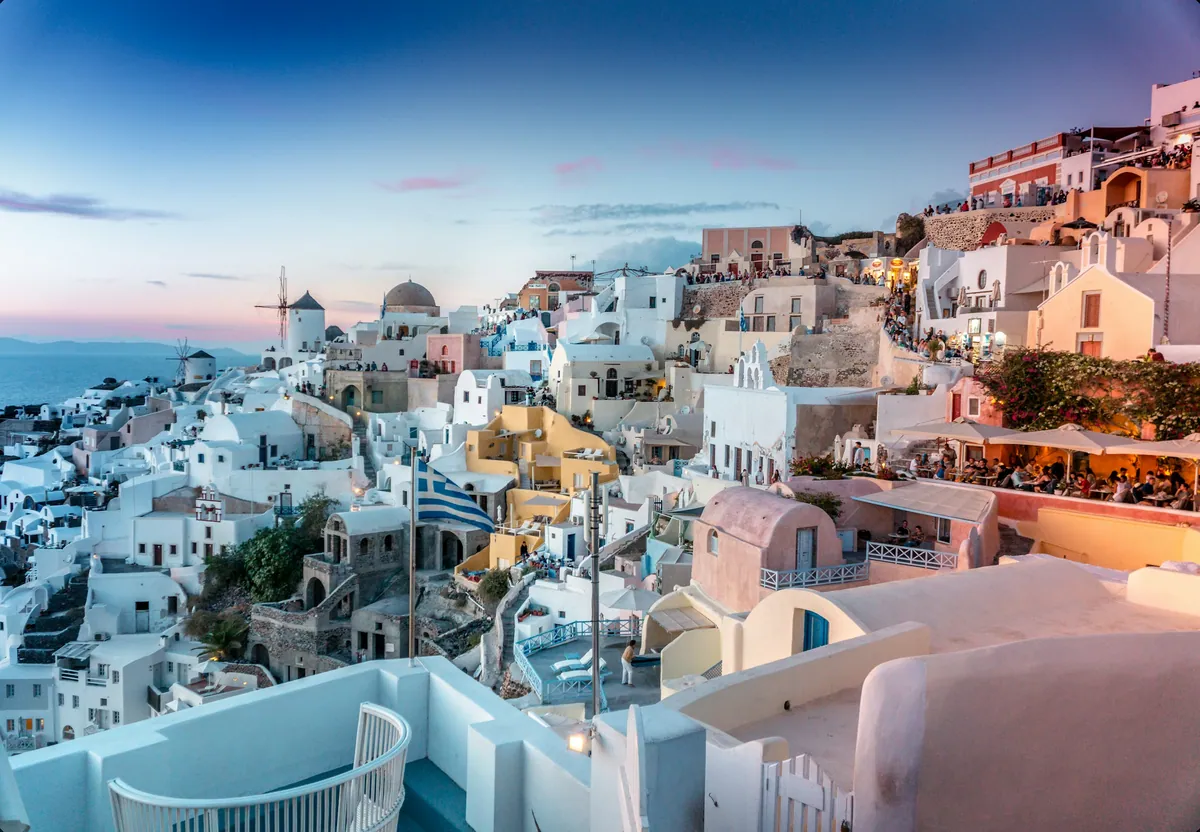
Santorini's traditional architecture shares the cubical, low-lying style of the wider Cyclades, built of local stone and whitewashed or limewashed, often tinted with volcanic ash pigments, a look that has largely defined the island's houses since before the major earthquake of 1956, which destroyed half the buildings and forced the evacuation of underground dwellings along the caldera ridge. A distinctive feature is the hypóskapha, rooms dug sideways or downward into the surrounding pumice, prized for insulation that keeps them cool in summer and warm in winter and often used to cellar wine in the island's Kánava wineries. That wine industry centres on the indigenous Assyrtiko grape, alongside white varieties such as Athiri and Aidani and reds including Mavrotragano and Mandilaria, grown on vines old enough to have survived the phylloxera epidemic of the late nineteenth century thanks to the island's volcanic soil, and trained in low, spiralling basket shapes to shield the grapes from wind; the island's Vinsanto, a sweet dessert wine aged in barrels for up to twenty or twenty-five years, is made from sun-dried grapes of the same varieties.
Tourism's growth in recent decades has driven much of the island's economic and population change, with an estimated 2 million visitors arriving annually and Santorini ranked among the world's top islands by outlets including Travel+Leisure, the BBC, and US News. The island has emphasised sustainable development and special-interest tourism such as conferences and sporting events, and closed its pumice quarries in 1986 to preserve the caldera; more recently, it has become a popular destination for pre-wedding photography, particularly among Asian couples drawn to its caldera-view landscape.
Beneath the tourism, Santorini's geology remains unusually active: the island sits on a small non-volcanic basement of metamorphosed limestone and schist dating to the Alpine orogeny, exposed at sites including Mikros Profititis Ilias and Mesa Vouno, within a metamorphic complex known as the Cycladic Massif that formed roughly 60 million years ago as the African Plate subducted beneath the Eurasian Plate. The island experienced further seismic activity as recently as 2025, a reminder that the same volcanic forces that shaped its caldera and its wine-growing soil remain part of daily life on Santorini today.
- Santorini — Wikipedia, CC BY-SA 4.0
Text adapted from the linked articles under CC BY-SA 4.0; edited for length.
Trip Snapshot
Highlights
Suitable For
Santorini Honeymoon, in frame
A quick visual sense of the landscapes, stays, and atmosphere your itinerary can be built around.
Build a Santorini Honeymoon itinerary around your dates.
Share your travel month, group size, budget comfort, and must-do experiences. The Taro team will shape the right route before any payment conversation.