Why Russia works
Russia, or the Russian Federation, spans Eastern Europe and North Asia as the largest country in the world, crossing eleven time zones and sharing land borders with fourteen countries. With a population of more than 140 million, it is the most populous country in Europe and the ninth-most populous in the world, and a highly urbanised one, with sixteen urban areas holding more than a million residents; Moscow, the most populous metropolitan area in Europe, is the capital and largest city, while Saint Petersburg is the country's second-largest city and a major cultural centre.
Human settlement on Russian territory dates back to the Lower Paleolithic, and the East Slavs emerged as a prominent European group between the third and eighth centuries AD, leading to the establishment of Kievan Rus' in the ninth century, which adopted Orthodox Christianity from the Byzantine Empire in 988. After Kievan Rus' disintegrated in the twelfth century, the Grand Principality of Moscow became the dominant Russian power and led the unification of Russian lands, culminating in the formation of the Tsardom of Russia in 1547; by the early eighteenth century, Russia had expanded significantly through conquest and annexation into the imperial state that would later carry it through revolution, the Soviet era, and the Cold War before its transition to a market economy.
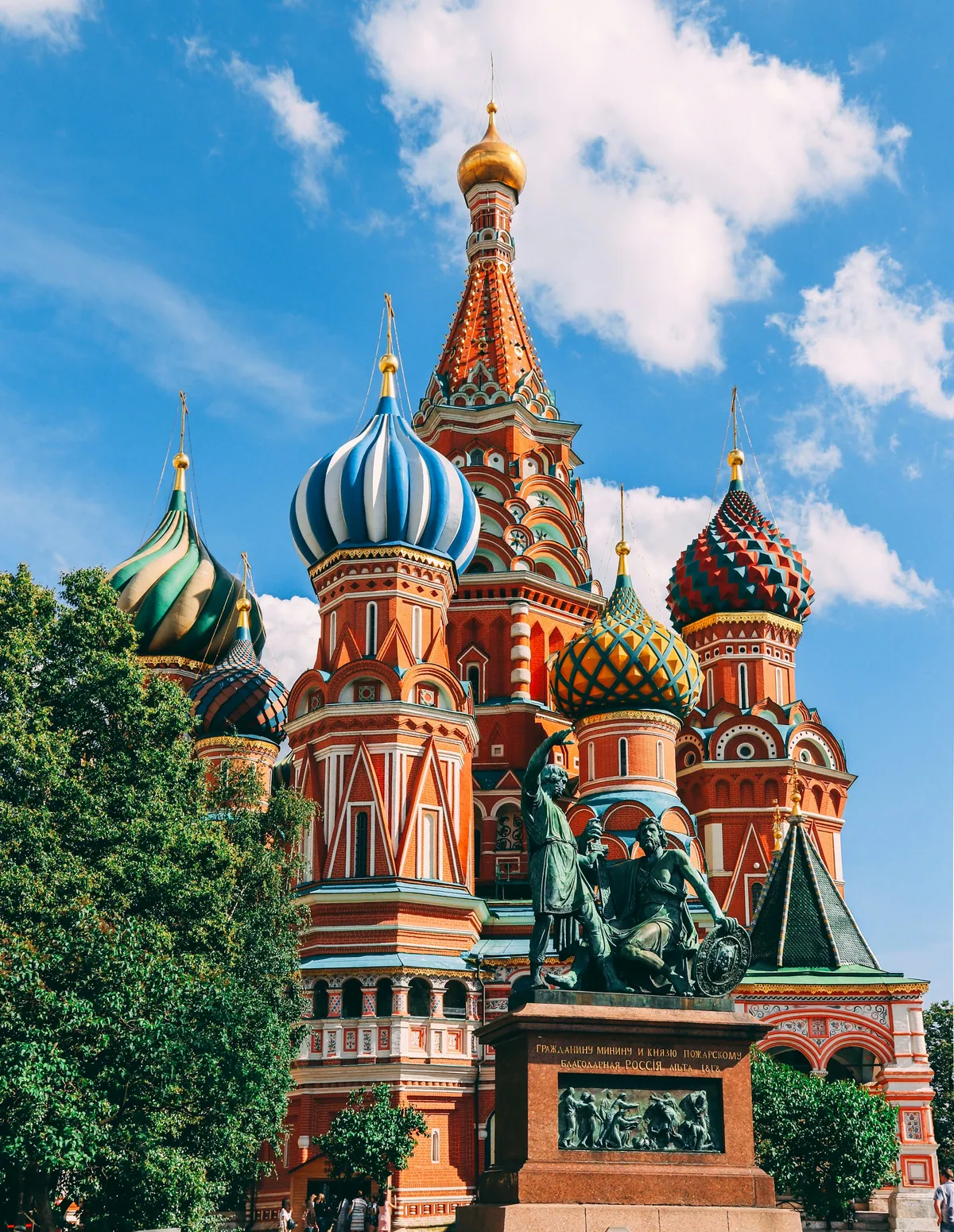
Russia's major tourist routes include a circuit of the Golden Ring's ancient cities, cruises along large rivers such as the Volga, hikes through the Caucasus Mountains, and journeys on the Trans-Siberian Railway, part of a national rail network exceeding 87,000 kilometres, the world's third-longest. The country's most visited landmarks include Red Square, the Peterhof Palace, the Kazan Kremlin, the Trinity Lavra of St. Sergius, and Lake Baikal, alongside the Moscow Kremlin and Saint Basil's Cathedral. Moscow itself retains a mix of classical and Soviet-era architecture alongside modern skyscrapers, while Saint Petersburg, the former imperial capital, is known for its classical architecture, cathedrals, museums, theatres, white nights, and network of crisscrossing rivers and canals; the country's museums, including the State Russian Museum, the State Hermitage, and the Tretyakov Gallery, and theatres such as the Bolshoi and the Mariinsky, form a major part of its cultural draw.
Russia's vast size and the distance of many regions from the sea mean a humid continental climate dominates most of the country outside the tundra and the extreme southwest, with mountain ranges to the south and east blocking warm air from the Indian and Pacific Oceans while the European Plain in the west and north stays open to Atlantic and Arctic influence. Most of northwest Russia and Siberia have a subarctic climate, with extremely severe winters in inner northeast Siberia, home to the Northern Pole of Cold in Sakha, where the record low temperature reached −71.2°C, while the coast of Krasnodar Krai on the Black Sea, including Sochi, has a humid subtropical climate with mild, wet winters. Russia's Arctic coastline and islands carry a polar climate, and winter precipitation across most of the country falls as snow.
Russian art traces back to icons and frescoes, with the fifteenth-century master Andrei Rublev creating some of the country's most treasured religious works, followed by the Russian Academy of Arts, founded in 1757 to bring Western secular painting techniques into Russian practice. The nineteenth century produced Romantic painters such as Karl Briullov, Alexander Ivanov, and the marine artist Ivan Aivazovsky, followed in the 1860s by the critical realist Peredvizhniki group led by Ivan Kramskoy, Ilya Repin, and Vasily Perov, and later by the Russian avant-garde of roughly 1890 to 1930, whose figures included Kazimir Malevich, Wassily Kandinsky, and Marc Chagall. Russia also holds one of the world's largest concentrations of energy resources, with the world's largest proven natural gas reserves and, as of 2023, standing as the second-largest producer and third-largest exporter of natural gas as well as the second-largest producer and exporter of crude oil.
- Russia — Wikipedia, CC BY-SA 4.0
Text adapted from the linked articles under CC BY-SA 4.0; edited for length.
Trip Snapshot
Highlights
Suitable For
Russia, in frame
A quick visual sense of the landscapes, stays, and atmosphere your itinerary can be built around.
Build a Russia itinerary around your dates.
Share your travel month, group size, budget comfort, and must-do experiences. The Taro team will shape the right route before any payment conversation.