Why Rajasthan works
Rajasthan, whose name means "Land of Kings," is a state in northwestern India and the largest Indian state by area, covering 342,239 square kilometres, or 10.4 percent of India's total geographical area. It sits on India's northwestern edge, taking in most of the Thar Desert, also known as the Great Indian Desert, and shares a border with the Pakistani provinces of Punjab and Sindh along the Sutlej-Indus river valley, while inside India it borders Punjab, Haryana, Uttar Pradesh, Madhya Pradesh, and Gujarat. Its major features include the ruins of the Indus Valley civilisation at Kalibangan and Balathal, the Dilwara Temples at Rajasthan's only hill station, Mount Abu, and the Keoladeo National Park at Bharatpur, a World Heritage Site known for its bird life; the state is also home to five national tiger reserves.
From the thirteenth century onward, the Rajputs resisted repeated incursions by Muslim Turk invaders and preserved Hindu culture at their courts, with the Ranas of Mewar leading that resistance among other kingdoms; earlier, a confederacy of Rajputs under Mularaja II of Gujarat had defeated an attempted Ghurid invasion at the Battle of Kasahrada in 1178, and Prithviraj Chauhan defeated Muhammad Ghori's forces at the First Battle of Tarain in 1191, before Ghori's decisive victory at the Second Battle of Tarain the following year brought part of Rajasthan under Muslim rule, centred on Nagaur and Ajmer. Rana Hammir Singh later defeated the Tughlaq dynasty and recovered a large portion of Rajasthan, and Rana Kumbha went on to defeat the Sultans of Malwa, Nagaur, and Gujarat, making Mewar the most powerful Rajput kingdom of its era.
Geographically, the state is defined by the Thar Desert and the Aravalli Range, which runs for more than 850 kilometres from southwest to northeast and divides Rajasthan into a sandy, less productive northwest, covering about three-fifths of the state, and a more fertile, higher-elevation southeast; Mount Abu, at the range's southwestern end, rises to 1,722 metres at its peak, Guru Shikhar. The state's tourism draws on forts and palaces in Jaipur, the lakes of Udaipur, temples in Rajsamand and Pali, sand dunes at Jaisalmer and Bikaner, havelis in Mandawa and Fatehpur, wildlife at Sawai Madhopur, the scenery of Mount Abu, and the cattle fair at Pushkar; architectural landmarks across the state include Jaipur's Jantar Mantar, the Mehrangarh Fort and stepwell of Jodhpur, the Dilwara Temples, Chittor Fort, the Lake Palace, and miniature paintings from Bundi.
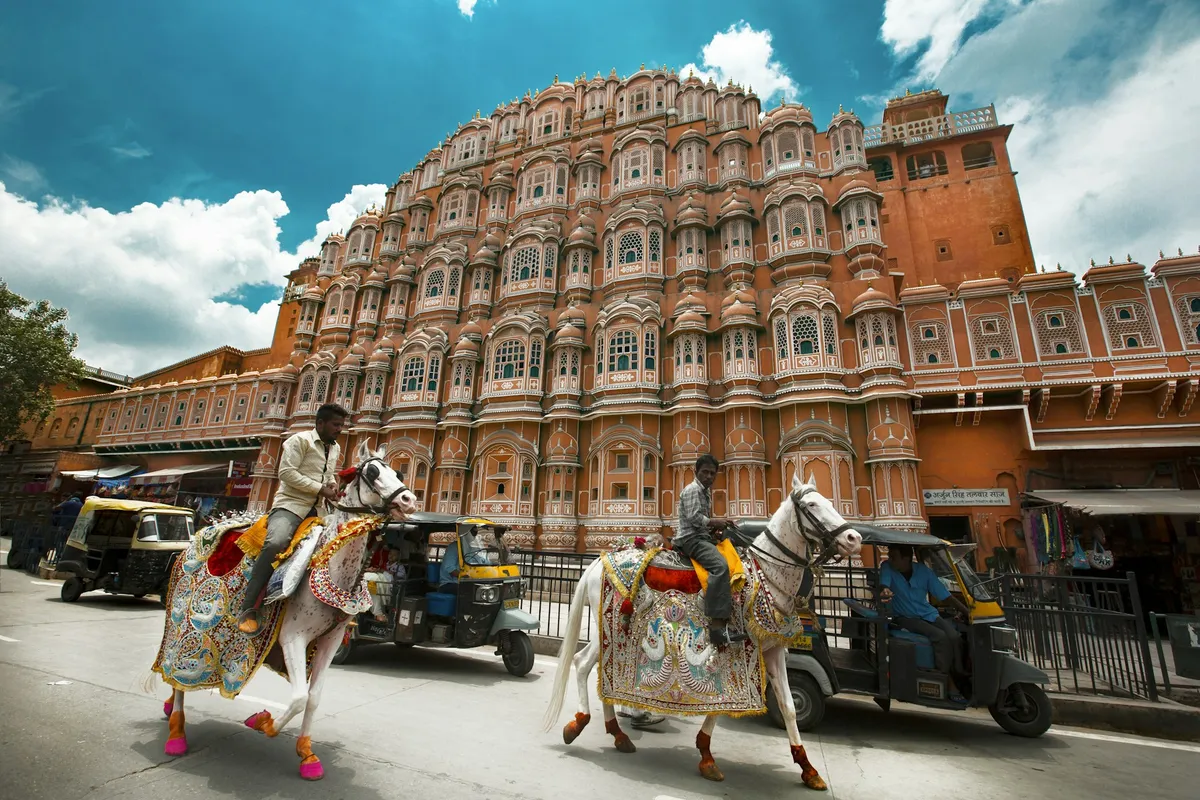
In 2017, Rajasthan attracted 45.9 million domestic and 1.6 million foreign tourists, the tenth-highest domestic total and fifth-highest foreign total among Indian states, and tourism has grown into a major source of income for the state government. Jaipur, the Pink City, takes its name from the sandstone hue of its old-city houses, while most houses in Jodhpur are painted blue, and Ajmer is known for white marble buildings; these colour-coded cities sit alongside the region's forts, palaces, folk dances and music, and local festivals as the visible face of Rajasthani culture.
Rajasthani cooking developed around the state's warlike history and its arid environment, favouring food that could last for days without needing to be reheated; its pickles are known for a tangy, spicy flavour, and the Panchkuta delicacy, made from wild desert plants, keeps for several days by the same logic. Water and fresh vegetables have always been scarce, which shaped snacks such as Bikaneri Bhujia and dishes including bajre ki roti, millet bread, and lahsun ki chutney, hot garlic paste, alongside regional specialities like mawa kachori and ghevar from Jodhpur, kadhi kachori from Ajmer, malpua from Pushkar, and rasgullas from Bikaner. Ghee remains essential to Rajasthani cuisine, poured over food as a gesture of welcome, and dal-baati-churma remains one of the state's most widely eaten dishes.
- Rajasthan — Wikipedia, CC BY-SA 4.0
Text adapted from the linked articles under CC BY-SA 4.0; edited for length.
Trip Snapshot
Suitable For
Rajasthan, in frame
A quick visual sense of the landscapes, stays, and atmosphere your itinerary can be built around.
Rajasthan questions, answered
When is the best time to visit Rajasthan?
October to March
What is the weather like in Rajasthan?
Semi-arid, hot summers, mild winters
Do I need a visa to travel to India?
No visa required (domestic). Visa rules change without notice — confirm current requirements with the destination's embassy or consulate before you book.
What currency is used in India?
Indian Rupee (INR)
What languages are spoken in India?
Hindi, Rajasthani, English
Build a Rajasthan itinerary around your dates.
Share your travel month, group size, budget comfort, and must-do experiences. The Taro team will shape the right route before any payment conversation.