Why Portugal works
Portugal, officially the Portuguese Republic, occupies the southwestern portion of the Iberian Peninsula in Southwestern Europe, bordered by Spain to the north and east, and also includes the archipelagos of Madeira and the Azores in the Atlantic Ocean. With a population of 11.4 million, Portugal has Lisbon as its capital and largest city, and its internal waters and territorial sea together account for two-fifths of its territory, giving it one of Europe's largest exclusive economic zones at 1,727,408 square kilometres. The country's land area is 92,225 square kilometres, though Portuguese law defines its overall size, including ocean waters, at 156,597 square kilometres.
Portugal was established as a county of the Kingdom of León in 868 during the Reconquista against Muslim rule of the Iberian Peninsula, which had begun in 711, and formally became a kingdom in 1179. After King Ferdinand I died in 1383 without a clear successor, John of Aviz was elected king in 1385 and defeated Castilian forces at the Battle of Aljubarrota, consolidating the House of Aviz; the following year Portugal signed the Treaty of Windsor with England, the oldest standing alliance in the world, and went on to acquire its first colony by conquering Ceuta in North Africa in 1415. Portugal was among the first countries to enter the Age of Discovery, and by the mid-16th century controlled a network of possessions stretching from Lisbon to Japan and Timor by way of Brazil, before becoming a republic in 1910 and a dictatorship in 1926, whose overthrow in 1974 restored democracy.
Portugal's highest point is the summit of Mount Pico on Pico Island in the Azores, rising 2,351 metres above sea level, and the mainland can be divided into four morphostructural units: the Hesperian Massif, which covers most of the mainland; the sedimentary Lusitanian and Algarve basins bordering it; the Lower Tagus and Alvalade sedimentary basins; and the volcanic submarine ranges that form the Azores and Madeira. The country's built heritage reflects a long visual-art tradition reaching back to the Palaeolithic, with early evidence of figurative art at the Prehistoric Rock Art Sites in the Côa Valley, and later distinctive styles including Manueline and Pombaline architecture alongside crafts such as azulejo tilework, talha dourada gilded woodwork, and Portuguese pavement, with regional variations visible in details like the thatched houses of Santana in Madeira.
Mainland Portugal and Madeira have a Mediterranean climate, while the Azores have a mainly temperate oceanic climate, and average temperatures vary from 4 to 20°C on the mainland, around 18°C in the Azores, and 9 to 19°C in Madeira. The Iberian Peninsula sits at the southern edge of the temperate zone and the northern edge of the subtropical high-pressure zone, and Portugal's weather is shaped by the seasonal shift of the jet stream, which brings the polar front and colder temperatures south in winter and gives way to the stabilising Azores High in summer. Wildfires remain a serious challenge: between 2014 and 2024 Portugal recorded an annual average of 12,496 fires and 112,455 hectares burned, with nearly 30 percent of 2024's fires of undetermined origin and arson accounting for almost five-sixths of the total area burned.
Portuguese cuisine draws on both Mediterranean and Atlantic traditions, built around seafood, brassicas, potatoes, bread, dairy, and olive oil; bacalhau, salt cod, has such a wide presence that it is considered a national dish alongside the pastel de nata, and traditional Portuguese sweets, known as conventual sweets, are made with generous quantities of sugar and eggs. Winemaking has been established in Portugal since the 7th century, producing wines including Port and Madeira, while beer has been brewed in the country since the Chalcolithic period and tea has been produced on São Miguel Island in the Azores since the nineteenth century.
- Portugal — Wikipedia, CC BY-SA 4.0
Text adapted from the linked articles under CC BY-SA 4.0; edited for length.
Trip Snapshot
Highlights
Suitable For
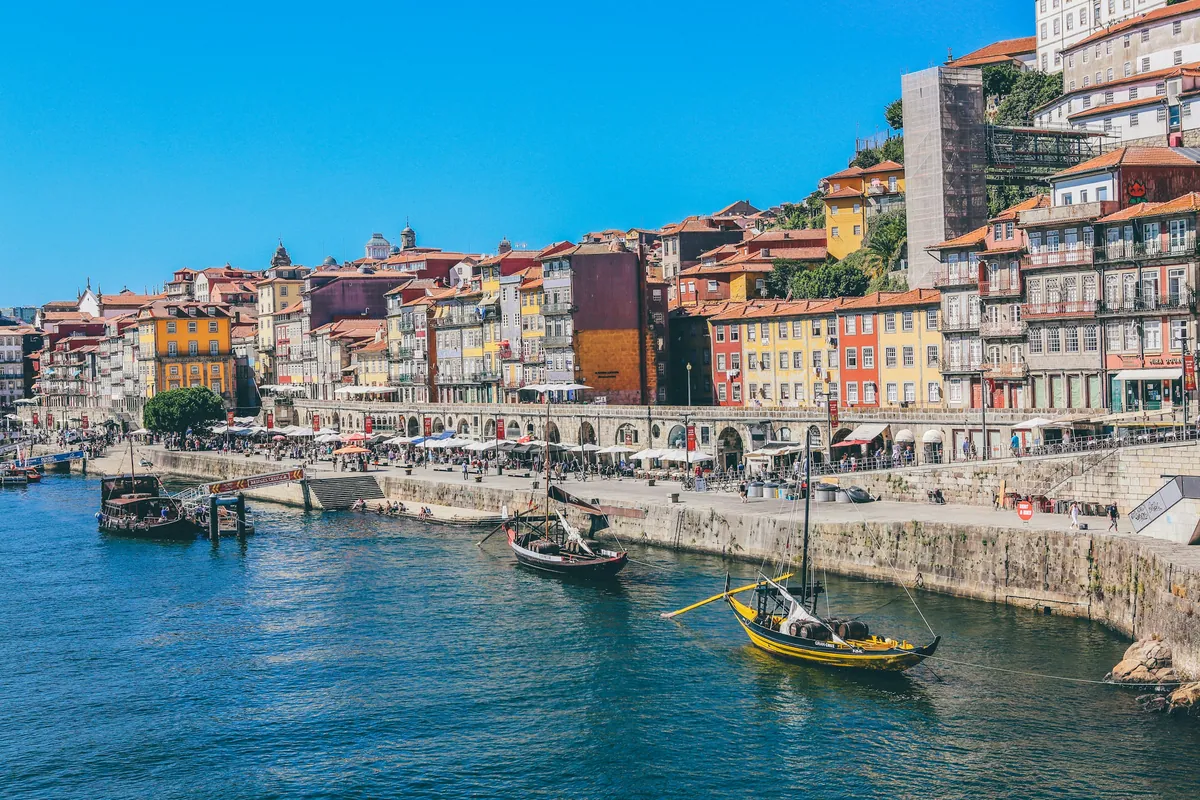
Portugal, in frame
A quick visual sense of the landscapes, stays, and atmosphere your itinerary can be built around.
Build a Portugal itinerary around your dates.
Share your travel month, group size, budget comfort, and must-do experiences. The Taro team will shape the right route before any payment conversation.