Why Philippines works
The Philippines, officially the Republic of the Philippines, is an archipelagic country in Southeast Asia in the western Pacific Ocean, made up of about 7,641 islands across a total area of roughly 300,000 square kilometres. The country is broadly divided from north to south into Luzon, the Visayas, and Mindanao, and is bounded by the South China Sea to the west, the Philippine Sea to the east, and the Celebes Sea to the south, sharing maritime borders with Taiwan, Japan, South Korea, Palau, Guam, Indonesia, Malaysia, Vietnam, and China. With a population of more than 114 million, it is the world's thirteenth-most-populous country, and Manila serves as its capital within the wider Metro Manila area, whose most populated city is Quezon City.
The archipelago's earliest inhabitants were the Negritos, followed by successive waves of Austronesian peoples who established island-kingdoms under animism, Hinduism with Buddhist influence, and later Islam; extensive overseas trade with neighbours, including the Tang and Song empires, brought Chinese traders to the islands as well. This layered heritage still shapes the country's diverse ethnicities and culture today, expressed across the eleven largest islands — Luzon, Mindanao, Samar, Negros, Palawan, Panay, Mindoro, Leyte, Cebu, Bohol, and Masbate — that together make up about 95 percent of its land area.
On Bohol, one of those eleven islands, the Chocolate Hills form a geological formation of at least 1,260 hills, and possibly as many as 1,776, spread across more than 50 square kilometres; covered in green grass that turns brown during the dry season, giving the hills their name, they appear on the provincial flag and seal as a symbol of Bohol's natural attractions and have been declared the country's third national geological monument, with a standing proposal for inclusion on UNESCO's World Heritage List. Elsewhere in the archipelago, the coastline runs 36,289 kilometres, the world's fifth-longest, and the country's highest peak, Mount Apo on Mindanao, rises to 2,954 metres, while the Cagayan River in northern Luzon, the country's longest, flows for about 520 kilometres.
The Philippines has a tropical maritime climate that is generally hot and humid, with three seasons: a hot dry season from March to May, a rainy season from June to November driven by the southwest monsoon, or habagat, and a cool dry season from December to February under the northeast monsoon, or amihan. Average annual temperature is around 26.6°C at sea level, though it drops to 18.3°C in the highland city of Baguio, and average humidity nationwide is 82 percent; annual rainfall reaches as high as 5,000 millimetres on the mountainous east coast but stays under 1,000 millimetres in some sheltered valleys. The Philippine Area of Responsibility sees around 19 typhoons in a typical year, mostly between July and October, with eight or nine making landfall.
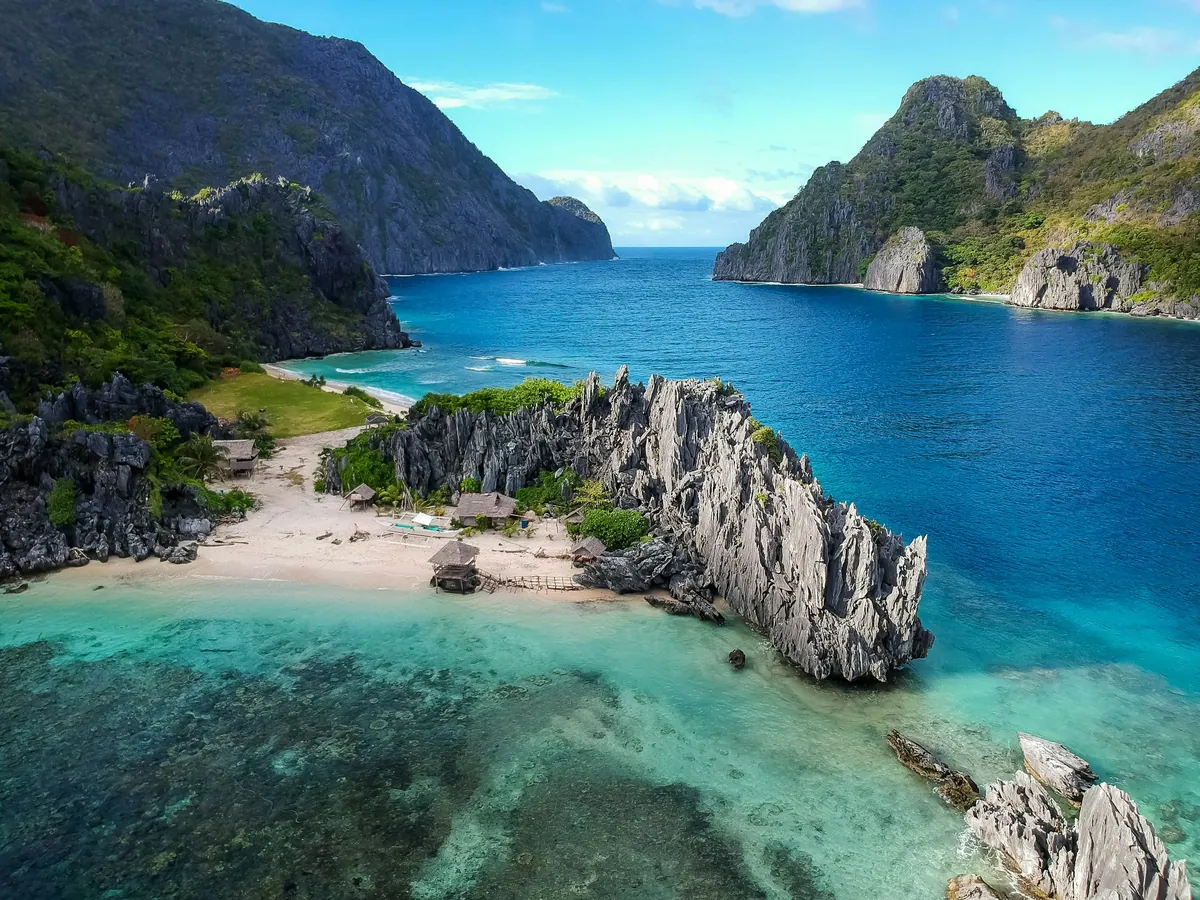
Tourism contributed 5.2 percent to Philippine GDP in 2021, down from 12.7 percent in 2019 before the pandemic, and supported 5.7 million jobs in 2019; the country attracted 5.45 million international visitors in 2023, about 30 percent below the pre-pandemic record of 8.26 million in 2019, with the largest shares of visitors arriving from South Korea, the United States, Japan, Australia, and China. Beyond Bohol's hills, the country's beaches and dive sites draw much of that traffic, with Boracay, Coron and El Nido in Palawan, Cebu, Siargao, and Bohol itself among its most visited spots.
- Philippines — Wikipedia, CC BY-SA 4.0
- Chocolate Hills — Wikipedia, CC BY-SA 4.0
Text adapted from the linked articles under CC BY-SA 4.0; edited for length.
Trip Snapshot
Highlights
Suitable For
Philippines, in frame
A quick visual sense of the landscapes, stays, and atmosphere your itinerary can be built around.
Build a Philippines itinerary around your dates.
Share your travel month, group size, budget comfort, and must-do experiences. The Taro team will shape the right route before any payment conversation.