Why Netherlands works
The Netherlands, informally known as Holland, is a country in Northwestern Europe with land borders to Germany in the east and Belgium in the south, plus a coastline on the North Sea and overseas territories in the Caribbean. Its name literally means "lower countries," a reference to its low, flat topography: about 26 percent of the country lies below sea level, much of it in polders reclaimed from water beginning in the fourteenth century. The country's twelve European provinces cover a total area of 41,543 square kilometres, and Dutch is the official language, with West Frisian holding secondary official status in Friesland.
Amsterdam grew into Europe's primary trading port for Baltic grain by the fifteenth century, before the Dutch Golden Age of the seventeenth century saw the country become one of the world's major seafaring and economic powers; by 1650 the Dutch merchant fleet numbered some 16,000 ships, and the Dutch East India and West India Companies established colonies and trading posts across the globe. This era also produced the "Dutch Masters" of painting, including Rembrandt, Johannes Vermeer and Jacob van Ruisdael, a tradition later carried into the nineteenth and twentieth centuries by Vincent van Gogh and Piet Mondrian.
Living with water has shaped Dutch history and engineering alike: the St. Lucia's flood of 1287 killed more than 50,000 people, and the North Sea flood of February 1953 drowned more than 1,800 more after several dikes collapsed in the southwest, prompting the government to build the Delta Works, a decades-long programme of sea and river defences completed in 1997 and later recognised by the American Society of Civil Engineers as one of the seven wonders of the modern world. The Wadden Sea in the north, rich in tidal flats and wetlands, is a UNESCO World Heritage Site, and the Netherlands maintains 21 national parks in total, including the Eastern Scheldt, its largest, created from a former river estuary in 2002.
Cycling is woven into daily Dutch life to a degree unmatched almost anywhere else: the Netherlands has an estimated 18 million bicycles, more than one per resident and roughly twice the number of registered motor vehicles, supported by some 35,000 kilometres of dedicated, physically separated cycle tracks and bicycle-specific traffic signals at busy junctions. In 2013 the European Cyclists' Federation ranked the Netherlands, alongside Denmark, as the most bicycle-friendly country in Europe. Rail travel is similarly dense, with more than 400 stations across a 3,013-kilometre network and trains running as often as eight times an hour on the busiest lines.
Schiphol Airport, just southwest of Amsterdam, is the country's main international gateway and the fourth-busiest airport in Europe, serving as the hub for KLM, the world's oldest airline still operating under its original name, with connections to more than 300 destinations worldwide. Amsterdam itself remains Europe's fourth-largest port, while Rotterdam, upstream on the Rhine and Meuse, is the largest port in Europe and was the world's tenth-largest container port as of 2022, underscoring how central water, from canals to container ships, remains to Dutch life today.
- Netherlands — Wikipedia, CC BY-SA 4.0
Text adapted from the linked articles under CC BY-SA 4.0; edited for length.
Trip Snapshot
Highlights
Suitable For
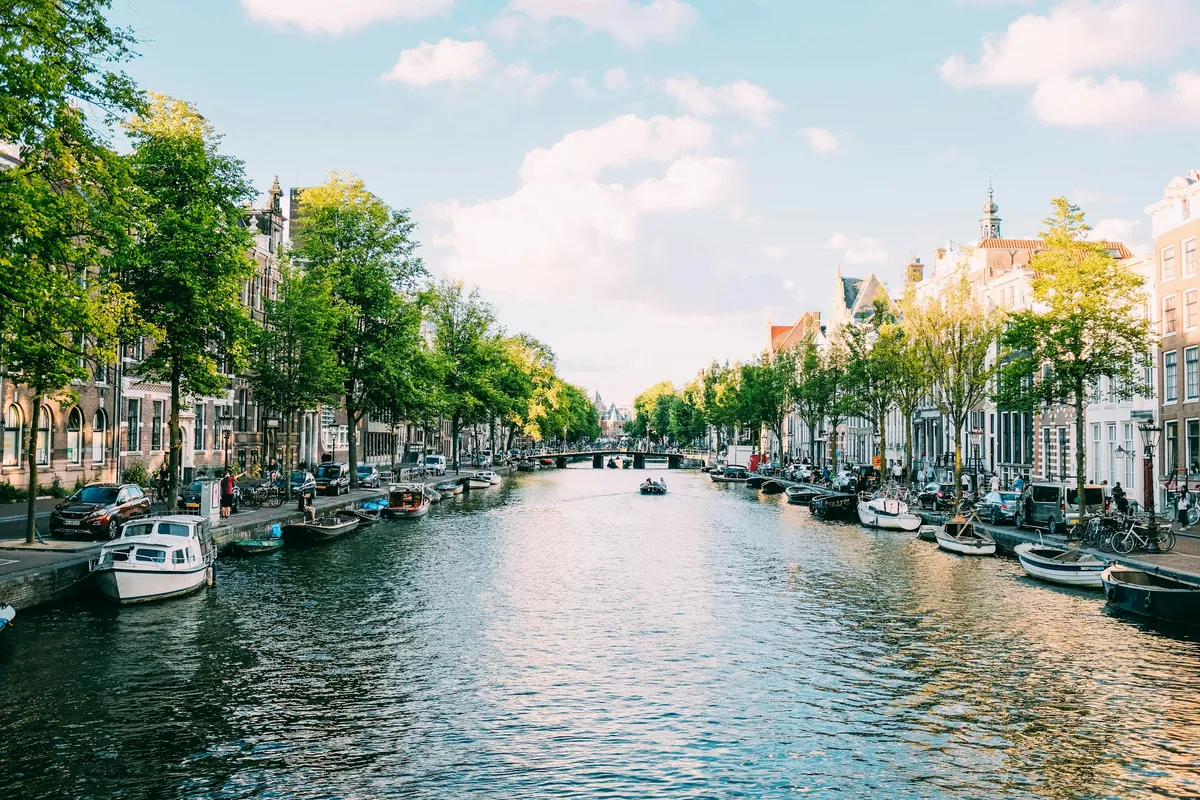
Netherlands, in frame
A quick visual sense of the landscapes, stays, and atmosphere your itinerary can be built around.
Build a Netherlands itinerary around your dates.
Share your travel month, group size, budget comfort, and must-do experiences. The Taro team will shape the right route before any payment conversation.