Why Nepal works
Nepal, officially the Federal Democratic Republic of Nepal, is a landlocked country in South Asia sitting mainly within the Himalayas, bordered by the Tibet Autonomous Region of China to the north and India on its three other sides. Its geography ranges from the fertile plains of the Indo-Gangetic Plain in the south to eight of the world's ten highest mountains, including Mount Everest, the highest point on Earth. Kathmandu is Nepal's capital and largest city, and the country is home to a multi-ethnic, multi-lingual and multi-religious population with Nepali as its official language.
Around 250 BC the Mauryan emperor Ashoka made a pilgrimage to Lumbini, revered in Buddhist tradition as the birthplace of Gautama Buddha, and erected a commemorative pillar whose inscriptions mark the starting point of Nepal's properly recorded history; he also visited the Kathmandu Valley, building monuments there as well. The valley itself, long the seat of the prosperous Newar civilisation known as Nepal Mandala, sat astride the Himalayan branch of the Silk Road and developed a distinct architectural tradition, later ruled in turn by the Licchavi and Malla dynasties before Prithvi Narayan Shah, king of Gorkha, conquered the valley in 1769 and set about unifying present-day Nepal under the Shah dynasty.
Kathmandu's characteristic pagoda architecture, developed by Newar artisans no later than the Licchavi period, was already renowned by around 650 AD, when a Tang dynasty Chinese travelogue described a seven-storied pagoda within a royal palace roofed in copper tile and set with fine stones. Beyond the capital, Pokhara and the Annapurna trekking circuit are premier draws for visitors, alongside four UNESCO World Heritage Sites: Lumbini, Sagarmatha National Park, home to Mount Everest, Chitwan National Park, and the seven monument zones of the Kathmandu Valley, collectively inscribed as a single site.
Nepal's dramatic range of elevation, from just 60 metres above sea level in the Terai plains to 8,848 metres atop Mount Everest, produces a correspondingly wide range of biomes and habitats; the country forms the western portion of the eastern Himalayan biodiversity hotspot and is home to 8.9 percent of the world's bird species and 4 percent of its mammal species, despite covering only a small fraction of the globe's land area. Forest now covers just over 40 percent of Nepal's land area, with the wetter eastern half of the country generally richer in biodiversity than the more arid high-elevation west.
Tourism is one of Nepal's largest and fastest-growing industries, employing more than a million people and contributing about 7.9 percent of GDP; international visitor numbers passed one million for the first time in 2018, not counting Indian tourists arriving overland. Nepal officially opened to Western visitors in 1951 and became a well-known stop on the hippie trail through the 1960s and 1970s, and most of the country's mountaineering income today still comes from Mount Everest, which is more accessible from the Nepalese side of the border than from Tibet.
- Nepal — Wikipedia, CC BY-SA 4.0
Text adapted from the linked articles under CC BY-SA 4.0; edited for length.
Trip Snapshot
Highlights
Suitable For
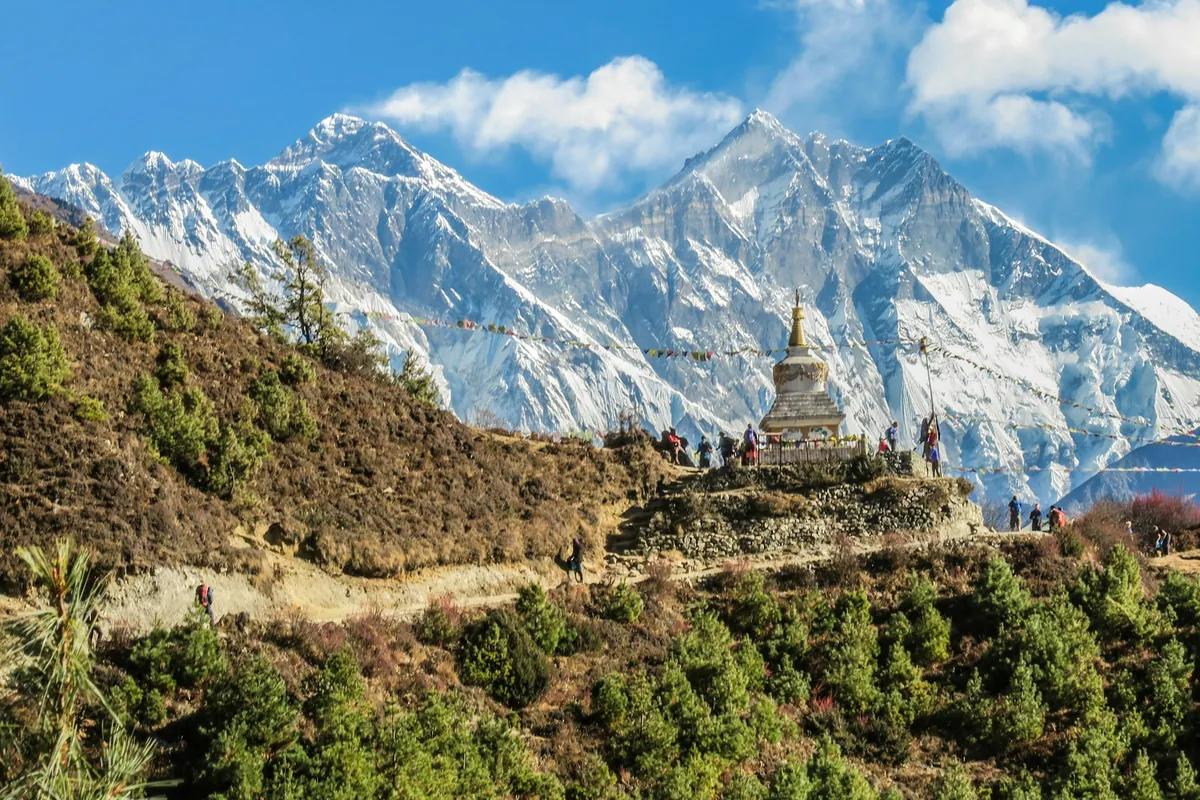
Nepal, in frame
A quick visual sense of the landscapes, stays, and atmosphere your itinerary can be built around.
Build a Nepal itinerary around your dates.
Share your travel month, group size, budget comfort, and must-do experiences. The Taro team will shape the right route before any payment conversation.