Why Malaysia works
Malaysia is a federal constitutional monarchy in Southeast Asia, made up of 13 states and three federal territories split by the South China Sea into Peninsular Malaysia on the Asian mainland and East Malaysia on the island of Borneo. Kuala Lumpur is the national capital and largest city, while nearby Putrajaya serves as the federal administrative capital; the country is home to more than 34 million people. Peninsular Malaysia borders Thailand by land and shares maritime boundaries with Singapore, Vietnam and Indonesia, while East Malaysia borders Brunei and Indonesia on Borneo. The Strait of Malacca, running between Sumatra and the peninsula, is one of the busiest shipping routes in the world, carrying around 40 percent of global trade.
Malaysia's Malay kingdoms came under British influence from the eighteenth century, including the British Straits Settlements protectorate, and were occupied by Japan during the Second World War before being briefly unified as the Malayan Union in 1946 and then restructured into the Federation of Malaya. The country gained independence on 31 August 1957, and on 16 September 1963 Malaya united with the former British colonies that would form the wider Malaysian federation. Earlier still, the Malacca Sultanate, founded in the early fifteenth century by Parameswara, grew into an important regional trading centre after his conversion to Islam, before Portugal conquered Malacca in 1511 and the Dutch took it in turn in 1641.
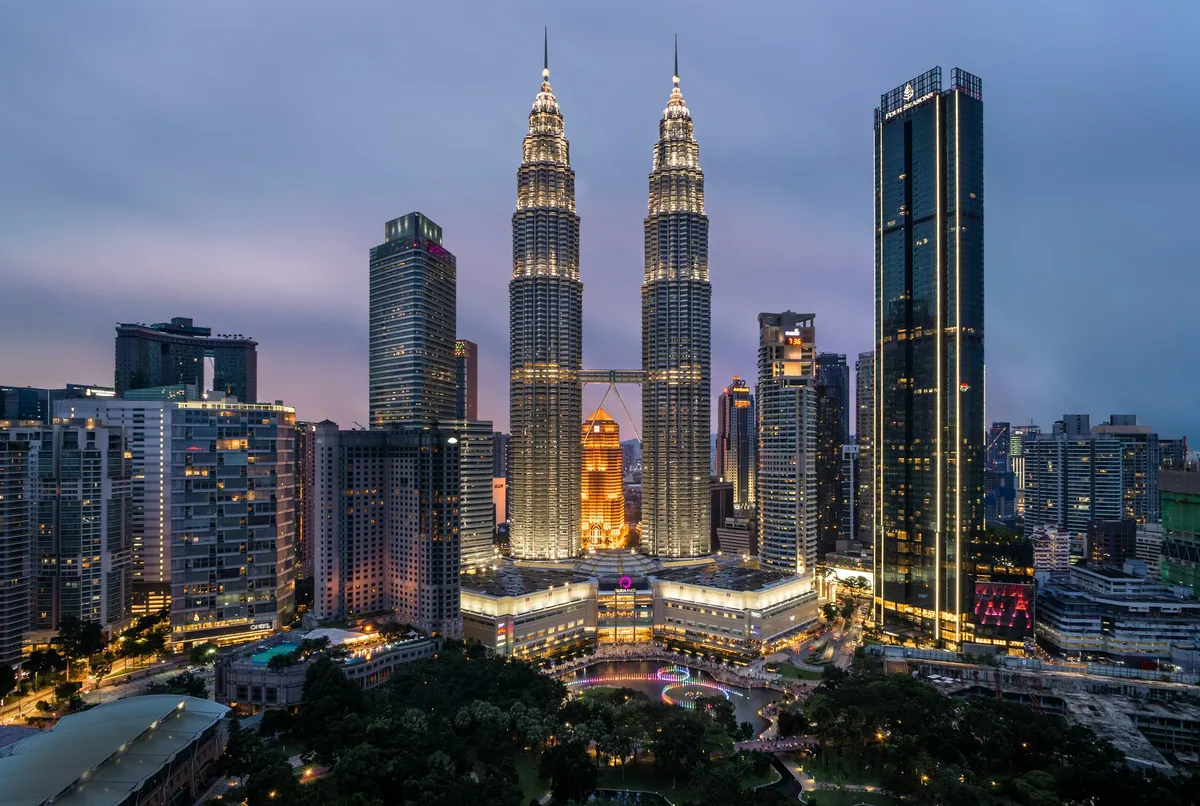
Kuala Lumpur's skyline is defined by the Petronas Towers, an interlinked pair of 88-storey skyscrapers rising 451.9 metres that were the tallest buildings in the world from 1998 until 2004 and remain the tallest twin towers anywhere; their steel-and-glass facade was designed to echo motifs from Islamic art, reflecting the country's Muslim heritage. Off Malaysia's northwestern coast, the duty-free archipelago of Langkawi comprises 99 islands developed as a tourist destination from the 1980s, with Pantai Cenang its most popular beach; two-thirds of the main island remains covered in forested mountains and hills, and its oldest rock formation, the Machinchang Formation, was among the first parts of Southeast Asia to rise from the sea, over half a billion years ago. On Borneo, Malaysia's rainforests support extraordinary levels of endemism, and the waters around the island of Sipadan are considered among the most biodiverse anywhere.
Malaysia is classified as megadiverse, estimated to hold around 20 percent of the world's animal species, with about 210 mammal species, more than 620 recorded bird species in Peninsular Malaysia alone, and roughly 250 reptile species including some 150 species of snakes. Its waters extend into the Coral Triangle, a marine biodiversity hotspot, and the Sulu Sea bordering East Malaysia holds around 600 coral species and 1,200 fish species. Malaysia signed the Rio Convention on Biological Diversity in 1993 and produced a National Biodiversity Strategy and Action Plan in 1998 to help manage this range of habitats.
Malaysia's economy is built substantially on trade through the Strait of Malacca and on manufacturing, alongside exports of natural and agricultural resources including petroleum; the country was once the world's largest producer of tin, rubber and palm oil. The Chinese community, which makes up about a quarter of Malaysia's population, plays an outsized role in the market economy as part of the broader network of overseas Chinese businesses across Southeast Asia. This mix of Malay, Chinese, Indian and indigenous communities has shaped a correspondingly layered cuisine and culture, visible in everything from the country's food to its festivals and languages.
- Malaysia — Wikipedia, CC BY-SA 4.0
- Petronas Towers — Wikipedia, CC BY-SA 4.0
- Langkawi — Wikipedia, CC BY-SA 4.0
Text adapted from the linked articles under CC BY-SA 4.0; edited for length.
Trip Snapshot
Highlights
Suitable For
Malaysia, in frame
A quick visual sense of the landscapes, stays, and atmosphere your itinerary can be built around.
Malaysia questions, answered
When is the best time to visit Malaysia?
March to October
Do I need a visa to travel to Malaysia?
e-Visa or visa on arrival for Indians. Visa rules change without notice — confirm current requirements with the destination's embassy or consulate before you book.
What currency is used in Malaysia?
Malaysian Ringgit (MYR)
What languages are spoken in Malaysia?
Malay, English widely spoken
Build a Malaysia itinerary around your dates.
Share your travel month, group size, budget comfort, and must-do experiences. The Taro team will shape the right route before any payment conversation.