Why Laos works
Laos, officially the Lao People's Democratic Republic, is a country in mainland Southeast Asia and the only landlocked country in the region, bordered by Myanmar and China to the northwest, Vietnam to the east, Cambodia to the southeast, and Thailand to the west and southwest. Vientiane is Laos's capital and largest city, and the country is home to more than 7.5 million people and three UNESCO World Heritage Sites: the town of Luang Prabang, the temple complex of Vat Phou, and the Plain of Jars. Laos's forested landscape is largely mountainous, rising to Phou Bia at 2,818 metres, with the Mekong River forming much of its western boundary with Thailand and the Annamite Range marking most of its eastern border with Vietnam.
The kingdom of Lan Xang, meaning "a million elephants," was founded by Prince Fa Ngum in the fourteenth century and became a regional trade hub before splitting into the three kingdoms of Luang Prabang, Vientiane and Champasak in 1707. France unified these under colonial rule as part of French Indochina in 1893, and after Japanese occupation during the Second World War, Laos regained full independence in 1953 as a constitutional monarchy under Sisavang Vong. A civil war between 1959 and 1975 pitted the communist Pathet Lao against the Royal Lao government, ending with the establishment of today's Lao People's Democratic Republic, which was admitted to ASEAN in July 1997.
Luang Prabang, the former royal capital, takes its name from the Phra Bang, a Buddha statue symbolising Lao sovereignty that was given to the kingdom's first monarch, Fa Ngum, in 1359; the city was designated a UNESCO World Heritage Site in 1995 for its blend of Lao architecture, European colonial buildings and more than thirty Buddhist temples, and its protected zone still covers 33 of its 58 villages, where the morning alms-giving ceremony continues as a daily ritual. About 29 kilometres south of Luang Prabang, roughly 53 minutes from the town's night market, the Kuang Si Falls drop 60 metres over white limestone in three cascading tiers into turquoise pools, a popular side trip fed by the Nam Si river as it descends from hills once home to Hmong, Lao Theung and Khmu villages. The Mekong River itself, running along Laos's western edge, remains a working transport corridor as well as a scenic one, its slow boats linking river towns along the way.
Laos has a tropical savanna climate shaped by the monsoon, with a rainy season running from May to October and a dry season from November to April, the final two months of which are hotter than those that precede them. The country's forests and river systems support more than 50 mammal species and nearly 300 bird species, including endangered animals such as the northern white-cheeked gibbon and the saola, protected within national parks like Nam Et-Phou Louey and Nakai-Nam Theun. In 1993 the government set aside 21 percent of Laos's land area for habitat conservation.
Tourism in Laos grew from about 80,000 international visitors in 1990 to 1.876 million by 2010, and topped 5 million visitors in 2024, contributing more than US$1 billion to the economy that year; roughly one in eleven jobs in the country was tied to tourism as of 2010. The Laotian National Tourism Administration has pursued a National Ecotourism Strategy alongside this growth, aimed at limiting the sector's environmental and cultural impact while channelling income toward conserving protected areas and cultural heritage sites. Rice dominates Lao agriculture, grown on about 80 percent of the country's arable land, and subsistence farming still accounts for roughly half of GDP and four in five jobs nationwide.
- Laos — Wikipedia, CC BY-SA 4.0
- Luang Prabang — Wikipedia, CC BY-SA 4.0
- Kuang Si Falls — Wikipedia, CC BY-SA 4.0
Text adapted from the linked articles under CC BY-SA 4.0; edited for length.
Trip Snapshot
Highlights
Suitable For
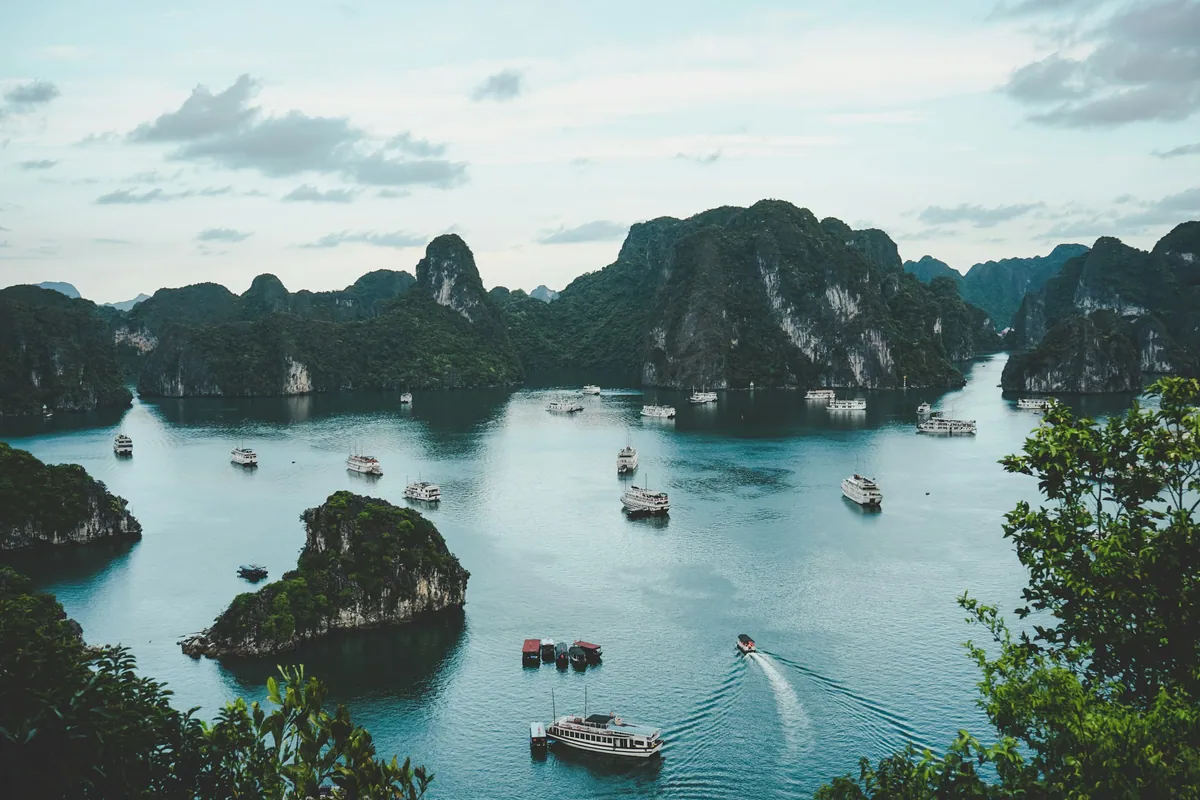
Laos, in frame
A quick visual sense of the landscapes, stays, and atmosphere your itinerary can be built around.
Build a Laos itinerary around your dates.
Share your travel month, group size, budget comfort, and must-do experiences. The Taro team will shape the right route before any payment conversation.