Why Ladakh works
Ladakh is a region administered by India as a union territory, forming the eastern portion of the wider Kashmir region and bordered by the Tibet Autonomous Region of China to the east, Himachal Pradesh to the south, the union territory of Jammu and Kashmir and Gilgit-Baltistan to the west, and Xinjiang across the Karakoram Pass to the north. It is the highest plateau region in India, with most of its territory sitting above 3,000 metres, extending from the Himalayas to the Kunlun ranges and including the upper Indus River valley; the mountain ranges here were built up over 45 million years as the Indian Plate folded into the Eurasian Plate, a collision that continues today and still produces frequent earthquakes. Leh, the region's largest city, and Kargil each serve as district headquarters, and Ladakh became a separate union territory of India on 31 October 2019, after having previously been part of the state of Jammu and Kashmir.
Rock carvings across Ladakh point to habitation from Neolithic times, and the region was part of the Kushan Empire around the first century CE, when Buddhism began spreading into western Ladakh from Kashmir. For much of the first millennium Ladakh sat between the kingdom of Zhangzhung and Kashmir, and by the ninth century a new West Tibetan kingdom, founded by Kyide Nyimagon's descendants, took shape in the region; King Bhagan united Ladakh under the Namgyal dynasty in 1460, a name that means "victorious" in Tibetan languages, and the Namgyals went on to repel Central Asian raiders and briefly extend their kingdom's reach toward Nepal. Ladakh's location at the crossroads of Central Asian trade routes long gave it strategic importance, though this trade dwindled once Chinese authorities closed the border between the Tibet Autonomous Region and Ladakh in the 1960s; the Indian government has encouraged tourism in the region as an alternative since 1974.
Among Ladakh's most photographed landmarks is Pangong Tso, an endorheic, saline lake stretching 134 kilometres at an elevation of 4,300 metres, more than two-thirds of it lying across the border in Chinese-administered territory; its waters freeze over in winter, and a marathon is held on the frozen lake each February to promote off-season tourism. To the north, the Nubra Valley — whose Tibetan name, Dumra, means "valley of flowers" — is a tri-armed valley formed where the Shyok and Nubra rivers meet, reached from Leh over the Khardung La pass at 5,359 metres; Khardung La was long popularly described as the highest motorable road in the world, though this status is no longer accepted by most authorities. Ladakh's Buddhist monasteries are also central to a visit: Hemis monastery, a leading centre of the Drukpa tradition, holds an annual masked-dance festival, a tradition shared by most major Ladakhi monasteries.
Scant precipitation makes Ladakh a high-altitude desert with sparse natural vegetation across most of its area, concentrated mainly along watercourses and irrigated village land; roughly 1,250 plant species, including cultivated crops, have been recorded here. Wildlife adapted to this cold, dry terrain includes the bharal, or blue sheep, the region's most abundant mountain ungulate and a preferred prey species of the rare snow leopard, alongside the Asiatic ibex, found mainly in western Ladakh with a population of around 6,000. In the Nubra Valley, irrigated village land produces wheat, barley, peas, mustard and orchard fruit including apricots and walnuts, a striking contrast with the surrounding high-elevation desert that gave the valley its name.
Ladakhi cuisine shares much with Tibetan food: thukpa, a noodle soup, and tsampa, roasted barley flour eaten without cooking and often carried as trekking food, are everyday staples, alongside heartier dishes such as skyu and chutagi. Traditional butter tea, called gurgur cha for the sound made while churning it with salt and butter, remains common alongside sweeter, milk-based tea. Leh is connected to the rest of India by two main roads, NH1 from Srinagar and NH3 from Manali, both maintained by the Border Roads Organisation, and by Kushok Bakula Rimpochee Airport, which operates daily flights to Delhi and weekly flights to Srinagar and Jammu.
- Ladakh — Wikipedia, CC BY-SA 4.0
- Pangong Tso — Wikipedia, CC BY-SA 4.0
- Nubra — Wikipedia, CC BY-SA 4.0
Text adapted from the linked articles under CC BY-SA 4.0; edited for length.
Trip Snapshot
Highlights
Suitable For
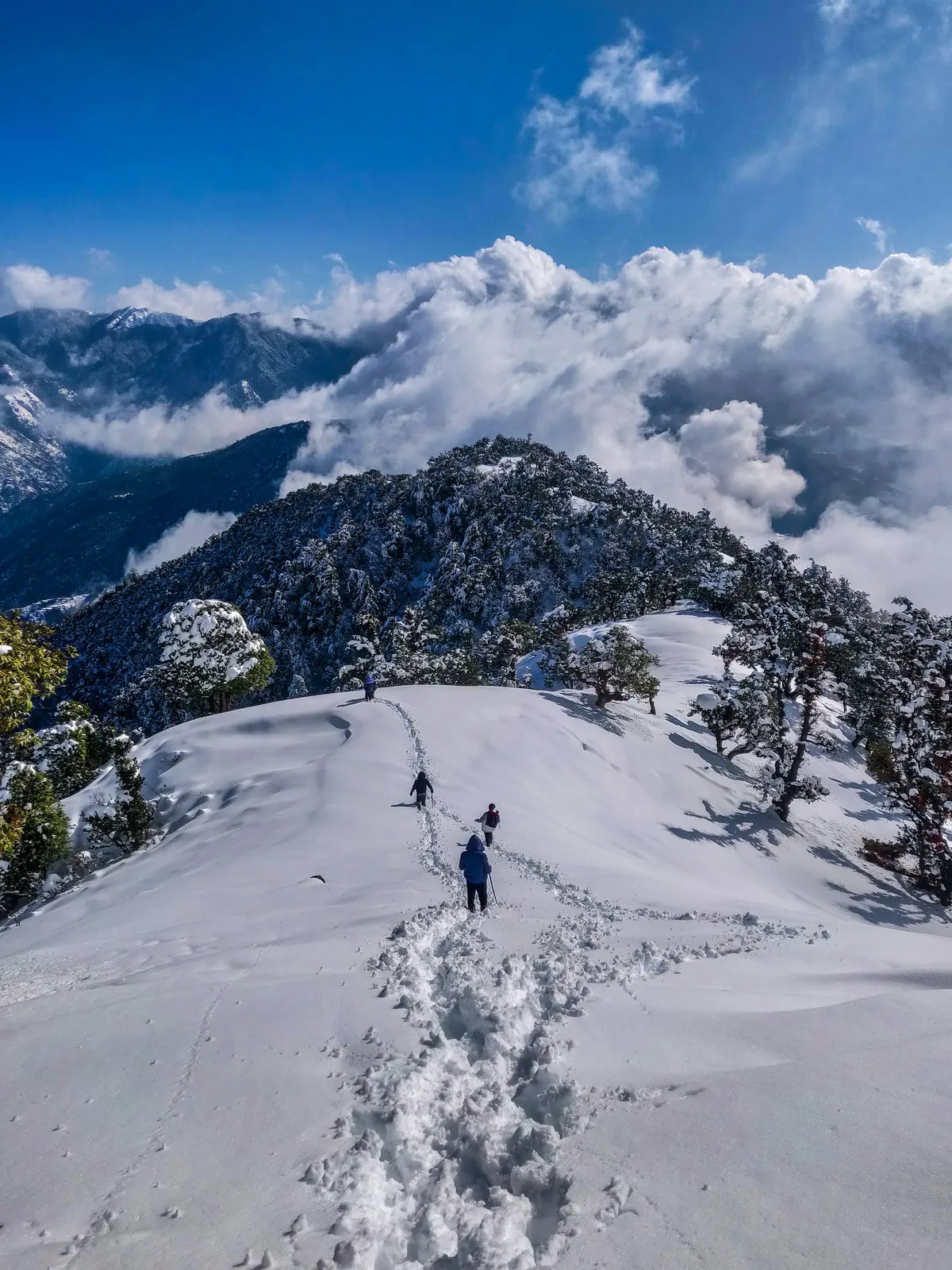
Ladakh, in frame
A quick visual sense of the landscapes, stays, and atmosphere your itinerary can be built around.
Build a Ladakh itinerary around your dates.
Share your travel month, group size, budget comfort, and must-do experiences. The Taro team will shape the right route before any payment conversation.