Why Kilimanjaro Climb works
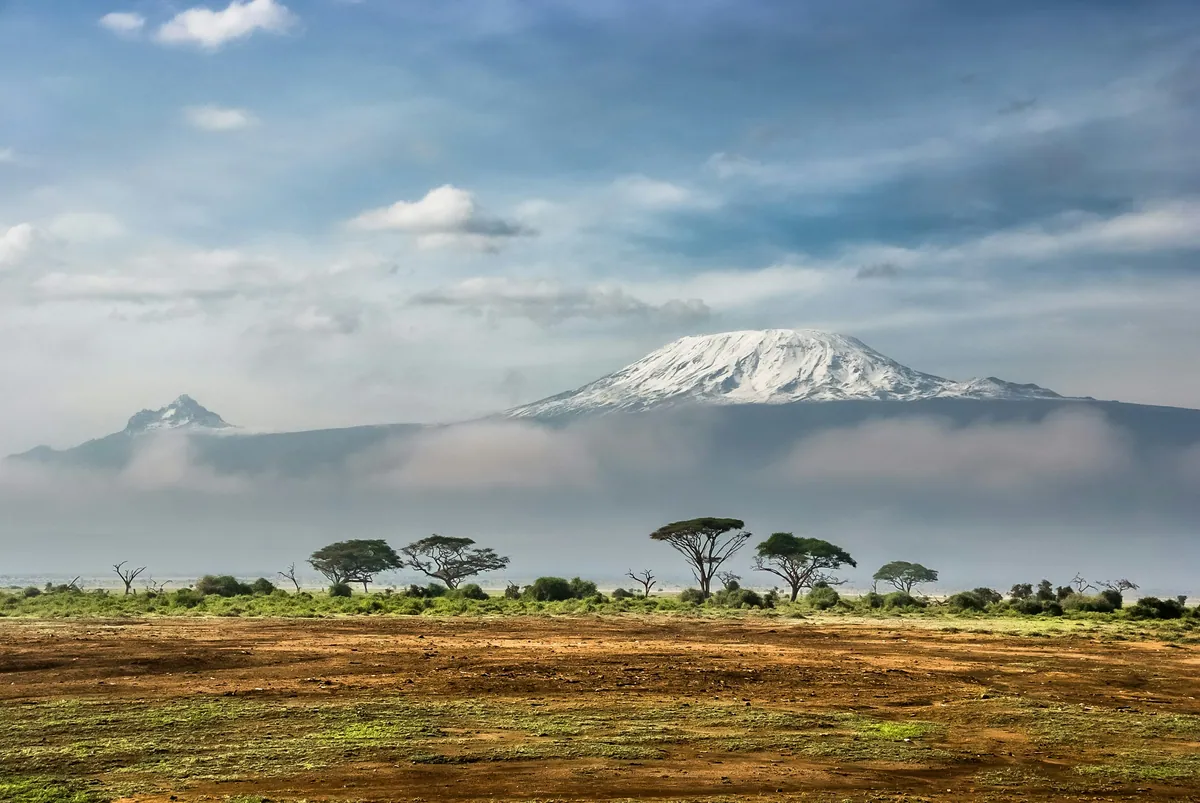
Mount Kilimanjaro is a large dormant stratovolcano in Tanzania, rising 5,895 metres above sea level and standing 4,900 metres above its own plateau base, which makes it the highest mountain in Africa and the highest free-standing mountain above sea level anywhere in the world. It is built from three distinct volcanic cones: Kibo, the highest and only one still dormant rather than extinct; Mawenzi, reaching 5,149 metres; and Shira, the lowest at 4,005 metres. Uhuru Peak, on Kibo's crater rim, is the mountain's official summit, its height first surveyed by the British in 1952 and remeasured several times since. Kilimanjaro rises out of the East African Rift and was formed by volcanic activity beginning more than two million years ago; its origin lies far from any ocean, making it one of very few tropical mountains anywhere to still carry a summit ice cap.
The mountain's southern and eastern slopes were the historic home of the Chagga people, organised for generations into sovereign Chagga states before these were abolished in 1963. The origin of the name Kilimanjaro is itself disputed among scholars, with one leading account tracing it to a Chagga phrase for "that which defeats" or "unclimbable," reinterpreted by early explorers as the mountain's own name. German missionary Johannes Rebmann is generally credited as the first European to report the mountain's existence, in 1848, describing a "beautiful white cloud" on the summit that his guide identified as snow; several further European expeditions attempted the peak over the following decades before the German geographer Hans Meyer became the first to reach Kibo's highest point, in 1889. The first woman to reach the summit, Sheila MacDonald, completed the ascent on 30 September 1927, two decades after Gertrude Benham's attempt was turned back by heavy snow and fog near what is now Gilman's Point.
Kilimanjaro was incorporated into Kilimanjaro National Park in 1973, and the mountain is now one of the Seven Summits and a major hiking and climbing destination, served by Kilimanjaro International Airport as its principal gateway. Seven official routes lead to Uhuru Peak — Lemosho, Machame, Marangu, Mweka, Rongai, Shira and Umbwe — of varying length and difficulty; the Marangu route, nicknamed the "Coca-Cola" route, is the shortest and most established, crossing the high-altitude semi-desert of the Saddle between Mawenzi and Kibo and offering hut accommodation rather than camping, while the Machame route typically takes six to seven days and the Lemosho route six to eight. Large animals are rare on the upper mountain but more frequent in its lower forests, where bushbucks, chameleons, dik-diks, duikers, mongooses and warthogs have been recorded, alongside zebras, leopards and hyenas seen occasionally on the Shira plateau.
Kilimanjaro's vegetation changes dramatically with elevation, moving from bushland and lower slope forest between 800 and 1,800 metres, through rainforest up to about 2,800 metres, heather and moorland to 4,000 metres, and alpine desert above that, before giving way to an arctic zone at the summit itself. The mountain has two rainy seasons, one running from March to May and a shorter one around November, with the wetter southern slopes receiving as much as 3,000 millimetres of rain a year in the forest belt while the alpine zone above sees closer to 200 millimetres; snowfall on the summit is possible at any time of year but is heaviest during these rainy periods. Kilimanjaro's ice cap, unusual for a mountain so close to the equator, has retreated significantly over the past century, and geological surveys show the glaciers here have persisted, in some form, for well over ten thousand years.
Kilimanjaro National Park generated US$51 million in revenue in 2013, the second-highest total of any national park in Tanzania, and roughly 50,000 trekkers a year now attempt the summit, with success rates that vary considerably by route and depend heavily on each climb's acclimatisation schedule and duration. The mountain hikers themselves generate seasonal employment for thousands of guides, porters and cooks each year, work that has become an established part of the local economy around towns such as Marangu on the mountain's lower slopes. The Tanzanian government has continued to invest in road access to the park given Kilimanjaro's standing as one of the most visited mountains in the world.
- Mount Kilimanjaro — Wikipedia, CC BY-SA 4.0
Text adapted from the linked articles under CC BY-SA 4.0; edited for length.
Trip Snapshot
Highlights
Suitable For
Kilimanjaro Climb, in frame
A quick visual sense of the landscapes, stays, and atmosphere your itinerary can be built around.
Build a Kilimanjaro Climb itinerary around your dates.
Share your travel month, group size, budget comfort, and must-do experiences. The Taro team will shape the right route before any payment conversation.