nature
Alleppey Backwaters
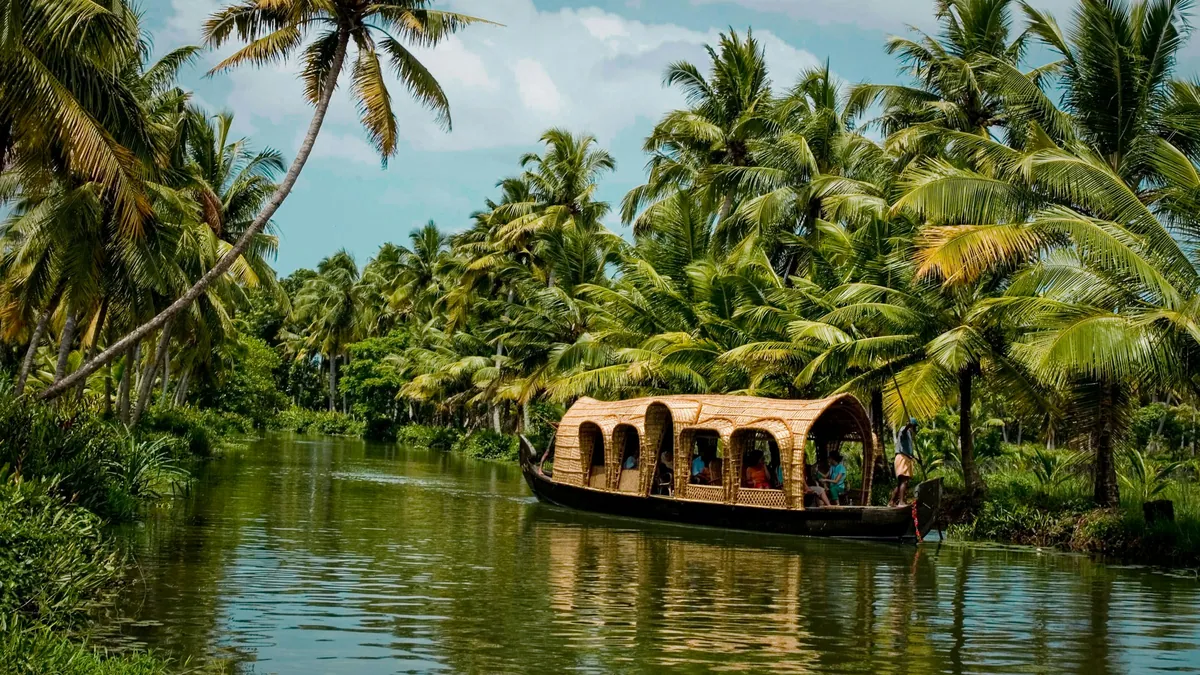
Venice of the East — cruise on a traditional kettuvallam houseboat through palm-fringed canals and paddy fields.
The Kerala backwaters are a network of brackish lagoons and canals running parallel to the Arabian Sea along the Malabar Coast of Kerala, in southern India, made up of more than 900 kilometres of interconnected lakes, rivers, canals and inlets that extend for roughly half the length of the state. Five large lakes are linked together by both natural channels and artificial canals, fed in turn by 38 rivers flowing down from the Western Ghats; of the 34 distinct backwater stretches recognised in Kerala, 27 lie close to or parallel with the Arabian Sea coast, while the remaining seven serve as inland navigation routes. The system formed as waves and shore currents built up low barrier islands across the mouths of the rivers descending from the Ghats, creating the labyrinth of waterways that towns such as Alappuzha and Kumarakom now sit within.
Vembanad, covering 2,033 square kilometres, is Kerala's largest lake and also the longest backwater and the longest lake in India, its canal network winding through the Kuttanad region and past Kochi city, Kumarakom and Pathiramanal Island. Fresh water flowing down rivers such as the Periyar, Pamba and Bharathappuzha meets seawater from the Arabian Sea within this system, creating a distinct ecosystem of brackish water; a barrage built near Thanneermukkom keeps salt water from intruding too far inland so the fresh water above it can still be used for irrigation. Three of the backwaters' wetlands — Ashtamudi Lake, Sasthamkotta Lake and the Vembanad-Kol wetlands — are recognised under the Ramsar Convention as wetlands of international importance, home to species including crabs, mudskippers, otters, turtles and water birds such as terns, kingfishers, darters and cormorants.
The most recognisable way to see the backwaters is aboard a kettuvallam, or Kerala houseboat: more than 2,000 of these now ply the waterways, classified by the state government into platinum, gold and silver tiers. The boats were traditionally built as grain barges to move rice harvested from the fields lining the backwaters, their wooden hulls up to 100 feet long topped with thatched roofs, and were at times used as living quarters by local royalty before being converted for tourism into floating cottages with sleeping areas, dining space and a sit-out deck open on at least three sides to the passing scenery. Regular ferries, run by the Kerala State Water Transport Department, offer a cheaper way to cross the backwaters for those not staying overnight on the water.
The Kuttanad region, crossed by waterways running beside paddy fields and plots of cassava, banana and yam, lies at the agricultural heart of the backwaters, irrigated by fresh water drawn from canals connected to Vembanad Lake; some of this farmland has been reclaimed from the backwaters themselves, in a manner the region's own accounts compare to the polders of the Netherlands. Fishing and fish curing remain important local industries alongside boat-making and coir work, trades that have supported communities along the backwaters for centuries even as the canals themselves double as an inexpensive transport corridor for local trade.
Each year, the backwaters host boat races built around the chundan vallam, or snake boat — a narrowboat more than 100 feet long with a raised prow standing some 10 feet above the water, traditionally used to carry soldiers during local wars and now raced by crews of around a hundred rowers apiece in the sport of vallam kali. The Nehru Trophy Boat Race traces its origin to a 1952 visit by India's first prime minister, Jawaharlal Nehru, who was received on the water by four traditional snake boats and later sent back a silver trophy to be raced for annually; the Thazhathangadi boat race on the Meenachil River, one of the oldest and most widely attended in the state, was witnessed by Ethiopia's Emperor Haile Selassie during his 1956 tour of India.
Text adapted from the linked articles under CC BY-SA 4.0; edited for length.
September-March is best — monsoon season (June-Aug) is magical but heavy rains
A quick visual sense of the landscapes, stays, and atmosphere your itinerary can be built around.
Venice of the East — cruise on a traditional kettuvallam houseboat through palm-fringed canals and paddy fields.
Emerald carpet of tea plantations at 1,600m — misty hills, Eravikulam National Park, and Neelakurinji blooms every 12 years.
Boat safari on Periyar Lake spotting wild elephants, bamboo rafting through the reserve, and spice garden walks.
Crescent-shaped lighthouse beach with Ayurvedic massage parlors lining the shore, surfing, and fresh seafood shacks.
Dramatic red laterite cliffs dropping to golden sand — oceanfront cafés, natural springs, and the 2,000-year-old Janardhana Temple.
Historic port district with Chinese fishing nets, Dutch Palace, Jewish Synagogue, vibrant street art, and the Kochi-Muziris Biennale.
Share your travel month, group size, budget comfort, and must-do experiences. The Taro team will shape the right route before any payment conversation.