Why Kerala works
Kerala, officially Keralam, is a state on the Malabar Coast of southern India, a narrow strip of coastal plain wedged between the Western Ghats and the Laccadive Sea, bordered by Karnataka to the northeast and Tamil Nadu to the east, with the Lakshadweep islands lying off its coast to the west. It was formed on 1 November 1956 under the States Reorganisation Act, which brought the region's Malayalam-speaking areas together into a single state; today it covers 38,863 square kilometres and is home to around 33 million people, making it India's 13th-most populous state. Thiruvananthapuram is Kerala's capital, while the Kochi metropolitan area is its most populated region, and Malayalam, alongside English, is the state's official language.
Kerala has been a spice exporter since at least 3000 BCE according to Sumerian records, a trade that drew ancient Babylonians, Assyrians, Egyptians, Arabs and Phoenicians to the Malabar Coast, and it is still known as the Garden of Spices. The Chera dynasty rose to prominence in the region through this maritime commerce, and the spice trade later drew Portuguese traders in the fifteenth century, when Vasco da Gama landed at Kappad near Kozhikode in 1498, beginning European colonisation of India. After Indian independence in 1947, the princely states of Travancore and Kochi joined the union and were merged in 1949, before the modern state of Kerala took its present shape in 1956 by combining these territories with the Malabar district of the former Madras State; the first elections to the new Kerala Legislative Assembly in 1957 produced a Communist-led government under E. M. S. Namboodiripad, among the earliest democratically elected communist governments anywhere in the world.
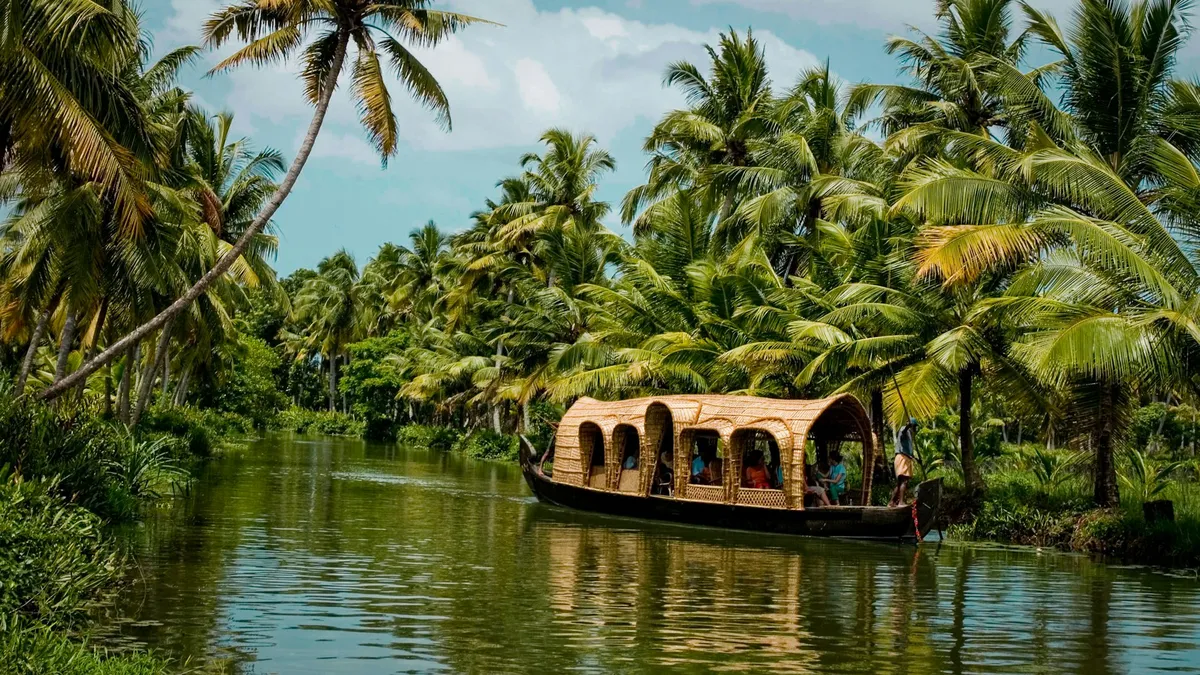
Visitors come to Kerala for its combination of beaches, backwaters, lakes, mountain ranges, waterfalls, historic ports and palaces, religious sites and wildlife sanctuaries, with the port city of Kochi drawing the largest number of both domestic and international arrivals. Culturally, Kerala's classical dance forms — Kathakali, Mohiniyattam, Koodiyattom, Thullal and Krishnanattam — developed under temple patronage over centuries, while temple festivals such as Thrissur Pooram bring caparisoned elephants, fireworks and large crowds each year, and the harvest festival of Onam, marked by a four-day public holiday in the Malayalam month of Chingam, recalls the state's agrarian past. The government declared tourism an important industry in 1986, making Kerala the first Indian state to do so, and travel here has grown from a relatively unknown niche in the early 1980s into one of the state's defining industries.
Kerala experiences a humid tropical climate with 120 to 140 rainy days a year, shaped by both the southwest summer monsoon and the northeast winter monsoon. Around 65 percent of the state's rainfall arrives with the Southwest monsoon between June and August — Kerala is typically the first Indian state to receive it, as moisture-laden winds off the Arabian Sea strike the Western Ghats — while the rest falls with the Northeast monsoon from September to December, mainly in the southern districts. Rainfall averages 2,923 millimetres a year overall, though the eastern Idukki district's mountains receive more than 5,000 millimetres through orographic rainfall, the highest in the state, while the drier lowlands see as little as 1,250 millimetres. The Western Ghats here rise to an average of 1,500 metres, with the highest peaks reaching around 2,500 metres, and Anamudi in Idukki district, at 2,695 metres, is the highest peak in South India.
Kerala's biodiversity is concentrated largely in the Western Ghats, which still cover about 24 percent of the state in forest despite extensive clearing for cultivation during the twentieth century; more than a quarter of India's recorded plant species grow here, including over 4,000 flowering plant species, more than a thousand of them found nowhere else. Four Ramsar Convention-listed wetlands — Lake Sasthamkotta, Ashtamudi Lake, the Thrissur-Ponnani Kole Wetlands and the Vembanad-Kol wetlands — lie within the state, alongside sections of the Nilgiri and Agasthyamala biosphere reserves. Kerala's cuisine reflects this agricultural richness: rice-based dishes such as idli, dosa, puttu and appam anchor the day, spice is used with a heavy hand befitting the region's trading history, and specialities like Thalassery biryani and a wide range of seafood dishes have become recognised styles of their own within Indian cooking.
- Kerala — Wikipedia, CC BY-SA 4.0
Text adapted from the linked articles under CC BY-SA 4.0; edited for length.
Trip Snapshot
Suitable For
Kerala, in frame
A quick visual sense of the landscapes, stays, and atmosphere your itinerary can be built around.
Kerala questions, answered
When is the best time to visit Kerala?
September to March
What is the weather like in Kerala?
Tropical, warm and humid
Do I need a visa to travel to India?
No visa required (domestic). Visa rules change without notice — confirm current requirements with the destination's embassy or consulate before you book.
What currency is used in India?
Indian Rupee (INR)
What languages are spoken in India?
Malayalam, English widely spoken
Build a Kerala itinerary around your dates.
Share your travel month, group size, budget comfort, and must-do experiences. The Taro team will shape the right route before any payment conversation.