nature
Masai Mara
Africa's greatest wildlife arena — the Great Migration, Big Five, and vast golden savannah stretching to the horizon.
Kenya, officially the Republic of Kenya, is a country in East Africa, bordered by South Sudan and Ethiopia to the north, Somalia to the east, Tanzania to the south, and Lake Victoria and Uganda to the west, with the Indian Ocean running along its southeastern coast. Kenya's capital and largest city is Nairobi, while Mombasa, a port city on Mombasa Island, is its second-largest and oldest. At 580,367 square kilometres, Kenya is the world's 47th-largest country. From the coastal lowlands the land rises to a highland interior split by the Great Rift Valley, with fertile plateaus around Lake Victoria and to the east; in the western highlands the terrain includes cold, snow-capped peaks on Mount Kenya, while other parts of the country turn dry, arid or semi-arid, including deserts such as the Chalbi Desert and the Nyiri Desert.
Kenya's coast was long home to Swahili city-states such as Mombasa, Malindi and Lamu, built by Bantu ironworking and farming communities who traded with Arab merchants from around the first century CE, a relationship that brought Islam and Arabic influence to the Swahili language. The Portuguese explorer Vasco da Gama called at Malindi in 1498, and Omani Arab traders later held sway along the coast before European colonial control took hold; a German protectorate over the Sultan of Zanzibar's coastal possessions was ceded to Britain in 1890, and the Uganda Railway soon opened the interior to European settlement. The Colony of Kenya took its official name in 1920, and Kenya's own path to independence ran through the Kenya African National Union led by Jomo Kenyatta; the Colony and Protectorate of Kenya both ended on 12 December 1963, when the United Kingdom ceded sovereignty, and Kenya became a republic exactly a year later under President Kenyatta.
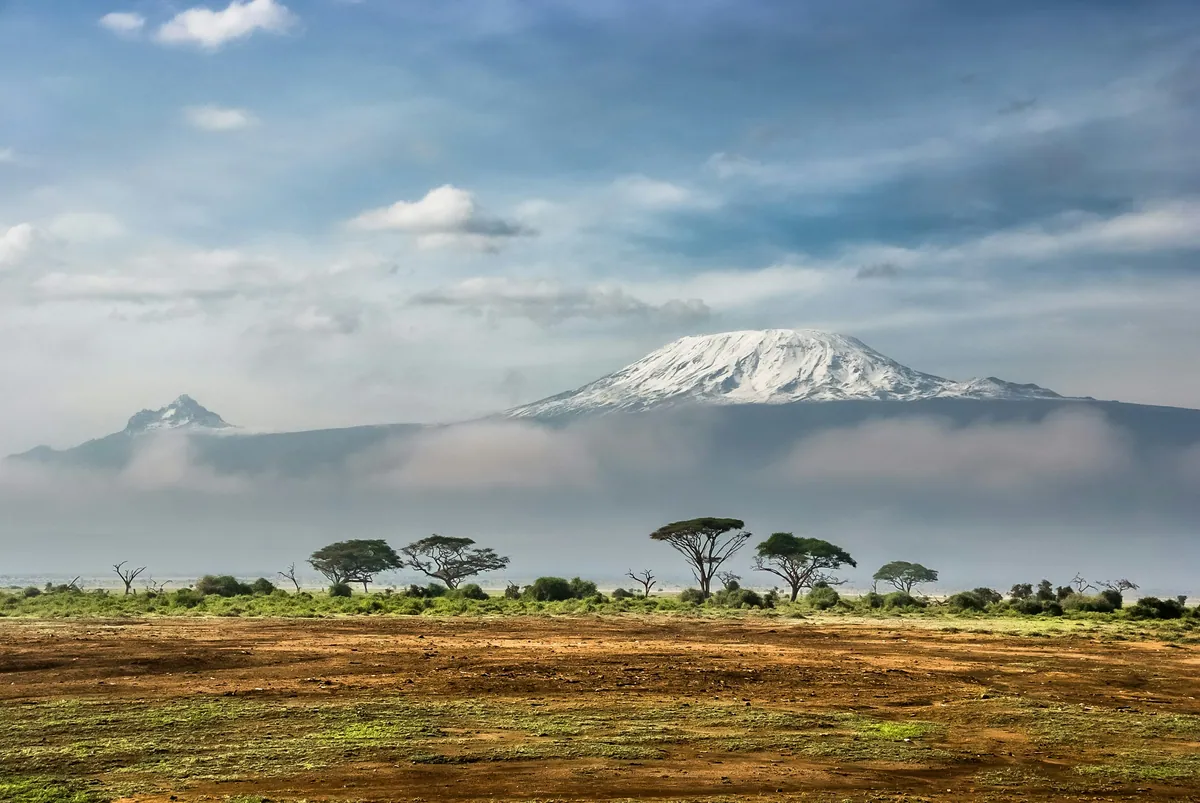
Kenya's main draw for visitors is its network of national parks and game reserves, of which the Maasai Mara National Reserve in Narok County is the most visited: named for the Maasai people and contiguous with Tanzania's Serengeti National Park across the border, it was first set aside as a wildlife sanctuary in 1961. It is here, along with the Serengeti, that the Big Five — lion, leopard, buffalo, rhinoceros and elephant — share the grassland with a resident population of black rhino, and where the Mara River crossings during the wildebeest migration draw photographers from around the world. Beyond the Mara, tourists are drawn to the snow-capped profile of Mount Kenya, which reaches 5,199 metres and holds glaciers despite sitting almost on the equator, to a view of Mount Kilimanjaro across the Tanzanian border, to the historic mosques and colonial-era forts of Mombasa, Malindi and Lamu on the Swahili Coast, and to the tea plantations around Kericho and coffee plantations around Thika.
Kenya's climate varies from tropical along the coast to temperate inland and arid in the north and northeast, with plenty of sunshine most months and cool nights at higher elevations. Rainfall follows two seasons: the "long rains" from March or April to May or June, and the "short rains" from October to November or December, with February and March the hottest months ahead of the long rains and July into mid-August the coolest. The Great Migration itself is timed to this rhythm — around two million wildebeest and hundreds of thousands of zebra move in a roughly clockwise circuit between the Serengeti and the Maasai Mara searching for fresh grazing and water, a movement recognised as one of the Seven Natural Wonders of Africa.
Tourism contributes around six percent of Kenya's economy and is the country's third-largest source of foreign exchange after remittances and agriculture, built mainly on photo safaris through some 60 national parks and reserves; visitors have historically come in the largest numbers from Germany and the United Kingdom. Kenya is divided into 47 semi-autonomous counties headed by elected governors, a structure introduced under the 2010 constitution, and functions as East Africa's transport and financial hub, with a well-developed, diversified financial sector. Away from the reserves, agriculture remains central to daily life and the export economy, with tea and coffee among the country's most valuable crops alongside horticultural produce.
Text adapted from the linked articles under CC BY-SA 4.0; edited for length.
Visit July-October for the Great Migration wildebeest crossing
A quick visual sense of the landscapes, stays, and atmosphere your itinerary can be built around.
Africa's greatest wildlife arena — the Great Migration, Big Five, and vast golden savannah stretching to the horizon.
East Africa's vibrant capital — Giraffe Centre, David Sheldrick elephant orphanage, Karen Blixen Museum, and buzzing food scene.
Iconic views of massive elephant herds framed against the snow-capped peak of Mount Kilimanjaro across the border.
Kenya's largest national park split into East and West — red elephants, lava flows, Mzima Springs, and raw wilderness.
Powdery white sand and turquoise Indian Ocean waters — snorkeling, kite surfing, and Colobus monkey forests.
Flamingo-fringed soda lake in the Great Rift Valley with rhino sanctuary and Baboon Cliff viewpoint.
July to October (Great Migration)
e-Visa required for Indian nationals. Visa rules change without notice — confirm current requirements with the destination's embassy or consulate before you book.
Kenyan Shilling (KES)
Swahili, English
Share your travel month, group size, budget comfort, and must-do experiences. The Taro team will shape the right route before any payment conversation.