Why Germany works
Germany, officially the Federal Republic of Germany, is a country in Western and Central Europe lying between the Baltic Sea and the North Sea to the north with the Alps to the south. Its 16 constituent states have a total population of over 83 million, making it the most populous member state of the European Union, and it borders Denmark to the north, Poland and the Czech Republic to the east, Austria and Switzerland to the south, and France, Luxembourg, Belgium, and the Netherlands to the west. Berlin is the nation's capital and most populous city, Frankfurt is its main financial centre, and the Ruhr forms its largest urban area.
Charlemagne founded the Carolingian Empire in 800, and after it was divided in 843 the eastern successor kingdom of East Francia, stretching from the Rhine to the Elbe and from the North Sea to the Alps, gave rise in turn to the Kingdom of Germany and the Holy Roman Empire. The Ottonian rulers, from 919 to 1024, consolidated several major duchies, and in 996 Gregory V became the first German pope, appointed by his cousin Otto III, whom he crowned Holy Roman Emperor shortly afterward. Under the Hohenstaufen emperors, from 1138 to 1254, German princes encouraged settlement to the south and east in a movement known as Ostsiedlung, while members of the Hanseatic League, mostly north German towns, prospered as trade expanded. Centuries later, following the fall of Napoleon, the Congress of Vienna founded the German Confederation, a loose league of 39 sovereign states, and the revolutions of 1848 raised the German question across the region, setting the stage for the unification later engineered by Otto von Bismarck under King William I of Prussia. Germany was later divided after the Second World War, and reunification in 1990 saw united Germany continue as the enlarged successor to West Germany, retaining its existing international memberships; under the Berlin/Bonn Act of 1994, Berlin again became the capital, with the relocation of government completed in 1999 while Bonn retained a share of federal ministries as a designated federal city. Since reunification, Germany has taken an increasingly active role in the European Union, signing the Maastricht Treaty in 1992 and the Lisbon Treaty in 2007 and co-founding the eurozone.
Germany is the seventh-largest country in Europe, covering 357,022 square kilometres, with elevation ranging from the Alps in the south, where the Zugspitze rises to 2,963 metres as the country's highest point, down to the shores of the North Sea in the northwest and the Baltic Sea in the northeast; the lowest point, in the municipality of Neuendorf-Sachsenbande in Wilstermarsch, sits 3.54 metres below sea level. Between these extremes, forested uplands in central Germany and lowlands in the north are crossed by major rivers including the Rhine, Danube, and Elbe.
That geography of forested uplands and river valleys still shapes German cuisine and drink today: German bakeries produce about 600 main types of bread and 1,200 types of pastries and rolls, and German cheeses account for about 22% of all cheese produced in Europe. Sausages appear in almost 1,500 varieties, including Bratwurst and Weißwurst, and beer remains the national alcoholic drink, with per capita consumption at 110 litres in 2013, among the highest in the world, under purity regulations dating to the 16th century.
Wine has also grown popular in many parts of the country, especially near Germany's established wine regions, and by 2019 Germany ranked as the ninth-largest wine producer in the world. Restaurant culture has followed a similar trajectory of recognition: the 2018 Michelin Guide awarded eleven German restaurants three stars, bringing the country's cumulative total to 300 stars. Between its river valleys, forested uplands, coastal lowlands, and Alpine south, Germany offers a range of landscape that runs in close parallel to the regional variety visible in its food and drink traditions.
- Germany — Wikipedia, CC BY-SA 4.0
Text adapted from the linked articles under CC BY-SA 4.0; edited for length.
Trip Snapshot
Highlights
Suitable For
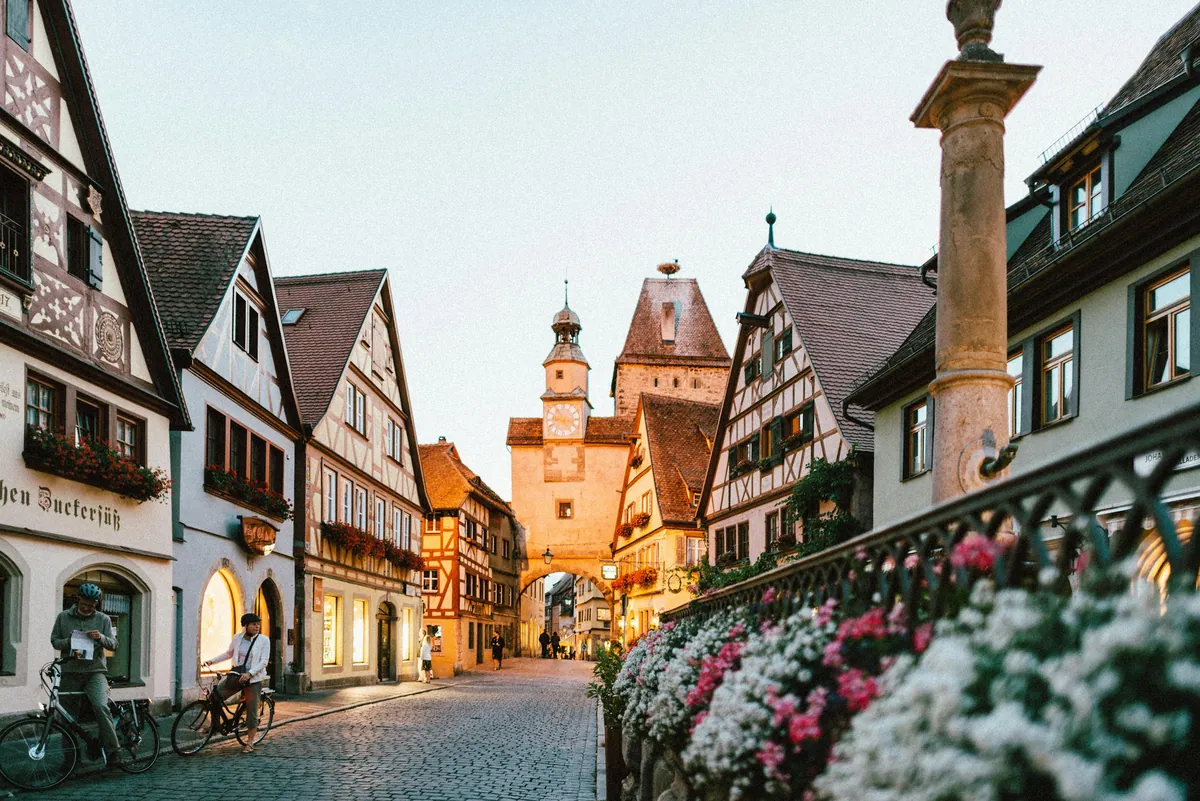
Germany, in frame
A quick visual sense of the landscapes, stays, and atmosphere your itinerary can be built around.
Build a Germany itinerary around your dates.
Share your travel month, group size, budget comfort, and must-do experiences. The Taro team will shape the right route before any payment conversation.