Why Everest Base Camp Trek works
There are two base camps on Mount Everest, on opposite sides of the mountain: South Base Camp sits in Nepal at 5,364 metres, while North Base Camp lies in Tibet at 5,150 metres. Trekkers on the popular Nepal-side route approach through Khumbu, also known as the Everest Region, part of the Solukhumbu District in Koshi Province and one of three subregions, alongside Solu and Pharak, settled historically by Sherpa and Kirat Rai communities. Khumbu's elevation ranges from 3,300 metres up to the 8,848.86-metre summit of Mount Everest itself, the highest point on Earth, and the region recorded a population of 3,456 people across 912 houses in the 2011 census.
Mount Everest, known in Nepali as Sagarmāthā, in Sherpa as Chamolangma, and in Tibetan as Jomolangma, lies in the Mahalangur Himal sub-range of the Himalayas and marks the China–Nepal border at its summit; its height was most recently measured in 2020 by a joint Nepalese-Chinese survey at 8,848.86 metres. The mountain's first confirmed ascent came on 29 May 1953, when New Zealander Edmund Hillary and Nepali Sherpa climber Tenzing Norgay reached the summit at 11:30 am local time via the South Col route, part of a ninth British expedition led by John Hunt; two days earlier, teammates Tom Bourdillon and Charles Evans had come within 100 metres of the top before turning back over oxygen problems, their routefinding and oxygen caches aiding the pair who followed. Both Hillary and Tenzing initially described the summit as a team effort, though Tenzing later revealed that Hillary had set foot on the top first.
From Lukla Airport, at 2,846 metres, roughly 40,000 people a year make the South Base Camp trek. Most trekkers fly from Kathmandu to Lukla before walking upward along the Dudh Kosi valley to Namche Bazaar, the Sherpa capital and central hub of the region at 3,440 metres, about two days from Lukla, where climbers typically rest a day to acclimatize before continuing another two days to Dingboche at 4,260 metres. Most trekkers follow the traditional trail via Tengboche monastery, home to a well-known Buddhist monastery in Khumbu, though the higher trail via Mong La and Phortse has gained popularity for its views. From there, the route continues to Everest Base Camp by way of Gorakshep, the flat field below Kala Patthar at 5,545 metres and Mount Pumori.
The Everest region sits within Sagarmatha National Park, established in 1976 across 1,148 square kilometres of the Solukhumbu District, ranging in elevation from 2,845 to 8,848 metres and encompassing Mount Everest itself; the park borders the Qomolangma National Nature Preserve to the north and Makalu Barun National Park to the east, and extends south to the Dudh Kosi river as part of the wider Sacred Himalayan Landscape. Along the trekking route, villages including Phakding, Monjo, Khumjung, Kunde, Pheriche, and Lobuche punctuate the trail alongside Namche Bazaar and Tengboche, each set within this protected high-altitude terrain.
The Khumbu Glacier, on which South Base Camp itself sits, has been melting and thinning rapidly enough that in June 2022 authorities announced the camp would be moved 200 to 400 metres lower. The camp had already been affected by natural events: the 25 April 2015 earthquake, measuring 7.8 on the moment magnitude scale, triggered an avalanche on Pumori that swept through South Base Camp, and a second earthquake on 12 May that year damaged some of the trails leading to it, requiring repairs. Supplies for the trek are still carried in largely by porters and yaks, since no roads connect Kathmandu to Lukla and aircraft remain the only way to move heavy goods into the region.
- Everest base camps — Wikipedia, CC BY-SA 4.0
- Khumbu — Wikipedia, CC BY-SA 4.0
- Mount Everest — Wikipedia, CC BY-SA 4.0
- Sagarmatha National Park — Wikipedia, CC BY-SA 4.0
Text adapted from the linked articles under CC BY-SA 4.0; edited for length.
Trip Snapshot
Highlights
Suitable For
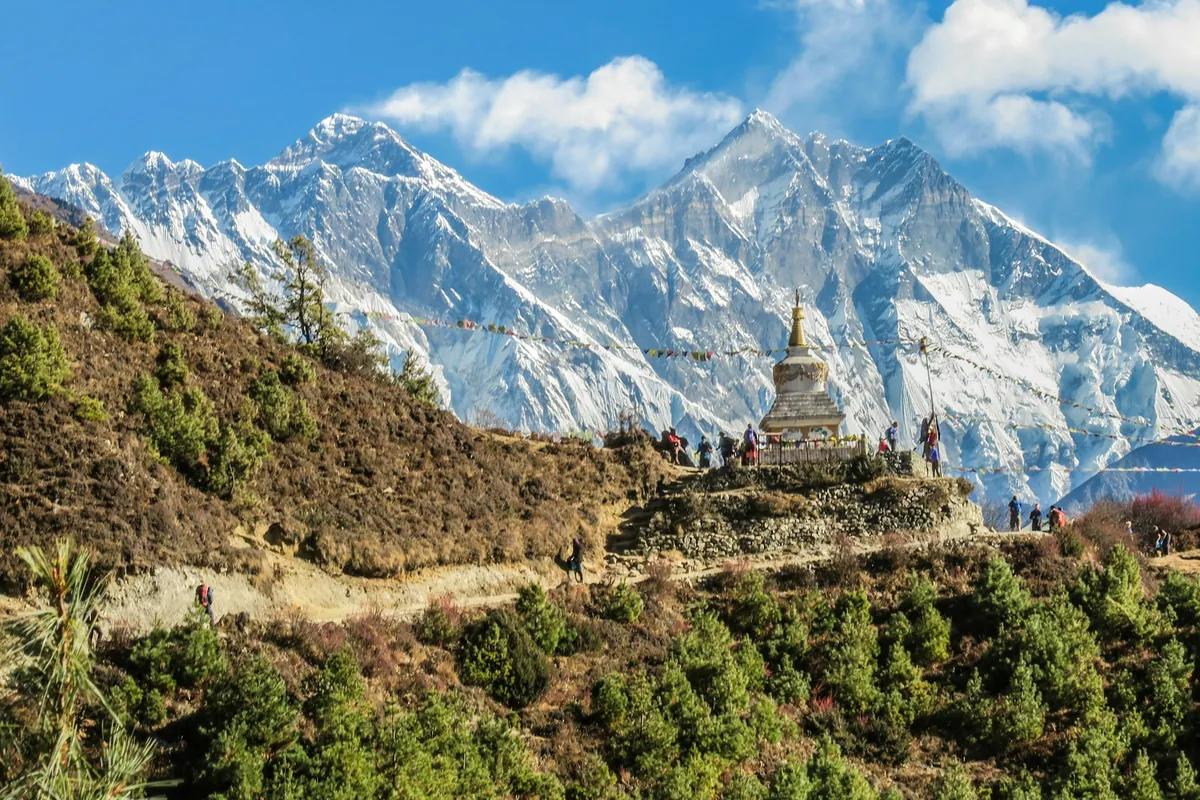
Everest Base Camp Trek, in frame
A quick visual sense of the landscapes, stays, and atmosphere your itinerary can be built around.
Build a Everest Base Camp Trek itinerary around your dates.
Share your travel month, group size, budget comfort, and must-do experiences. The Taro team will shape the right route before any payment conversation.