Why Dubai works
Dubai is the most populous city in the United Arab Emirates and the capital of the Emirate of Dubai, sitting on a creek along the southeastern coast of the Persian Gulf. As of 2025 its population stands at 4 million, 92% of whom are expatriates, while the wider urban area including Sharjah reaches 5 million and the Dubai–Sharjah–Ajman metropolitan area reaches 6 million. The emirate of Dubai borders Abu Dhabi to the south, Sharjah to the northeast, and Oman to the southeast, and covers 1,588 square miles, an area expanded well beyond its original designation through land reclamation from the sea.
Before oil, Dubai was an important regional centre for the collection, sale, and trade of pearls, and the collapse of that pearling industry plunged the city into a deep depression that pushed many residents into poverty or migration elsewhere along the Gulf. An oil exploration contract was signed in 1937, though the outbreak of the Second World War delayed any strike until 1966, when oil was found in Dubai's territorial waters in far smaller quantities than in neighbouring Abu Dhabi; the first field was named Fateh, meaning "good fortune." Sheikh Rashid bin Saeed Al Maktoum, ruler from 1958, had already used revenue from trading activity to build infrastructure even without oil wealth, and the oil discovery accelerated those plans, triggering a construction boom and a huge influx of foreign workers that saw the city's population grow by more than 300% between 1968 and 1975. The 1979 establishment of the deep-water Jebel Ali port, followed by the Jebel Ali Free Zone in 1985, opened the way for unrestricted import of labour and export of capital by foreign companies, setting the pattern for the trade-driven city that followed.
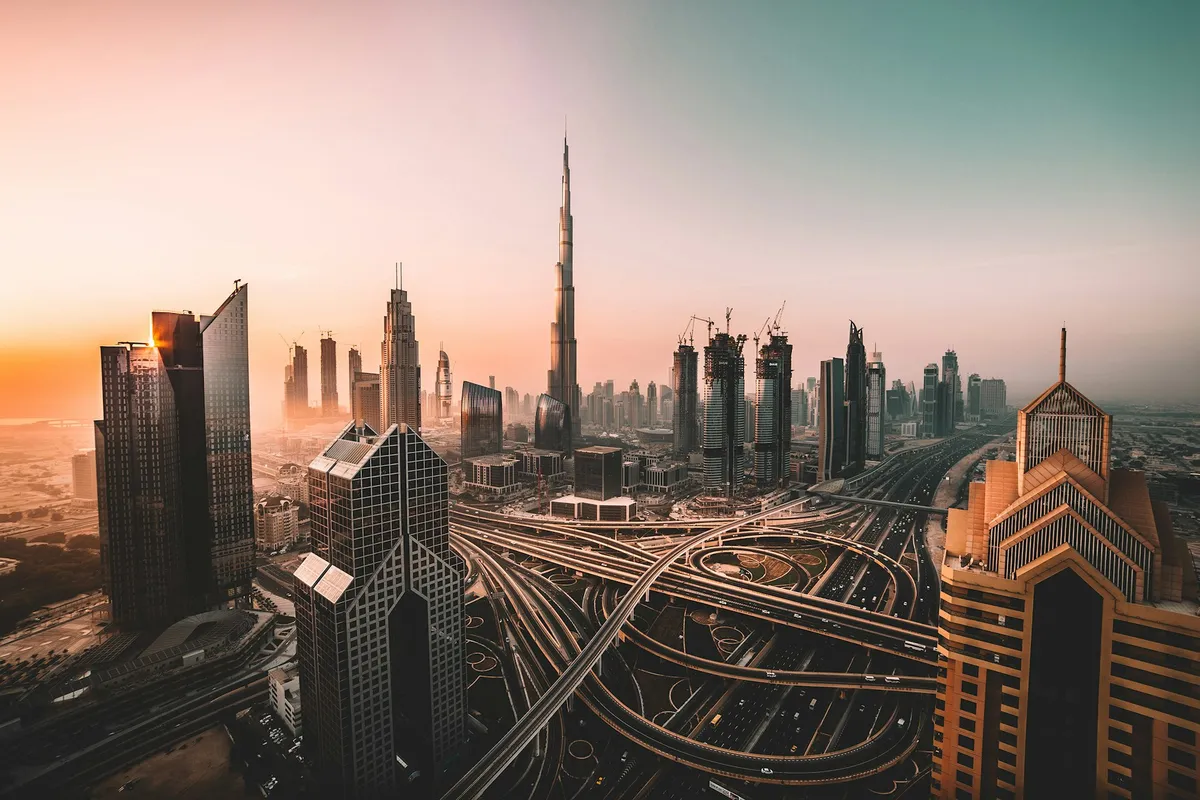
That growth produced the skyline visitors now come to see. The Burj Khalifa, at 828 metres the tallest building in the world, was built by more than 30 contracting companies with workers from 100 nationalities between 2004 and 2009 and opened on 4 January 2010, its form inspired by the desert flower Hymenocallis. The Palm Jumeirah, an artificial archipelago built by land reclamation between 2001 and 2006, is the smallest and original of the three planned Palm Islands extending into the Persian Gulf. The Burj Al Arab luxury hotel, which opened in December 1999, is frequently called "the world's only 7-star" hotel, a label its own management has never claimed and has said it does not encourage.
Dubai lies directly in the Arabian Desert and features a hot desert climate, with summers that are extremely hot, prolonged, windy, and humid — average highs around 40°C and overnight lows near 30°C in August, the hottest month — while winters are mild to warm, averaging 24°C by day and 14°C overnight in January, the coolest month. Humidity in summer runs very high, with dew points that can exceed 30°C and heat index values reaching over 60°C at the height of the season; the highest temperature ever recorded in Dubai is 49.0°C. Rainfall is sparse, averaging 79.2 millimetres a year historically, though annual precipitation has been increasing in recent decades toward 110.7 millimetres.
Arabic cuisine is available throughout the city, from small shawarma diners in areas like Deira and Al Karama to hotel restaurants, alongside widely available fast food, South Asian, and Chinese food, with biryani also popular. The sale and consumption of pork is regulated, legally permitted only to non-Muslims in designated areas of supermarkets and airports, and alcohol sale is similarly regulated, requiring a licence though available at hotel bars and restaurants. Traditional Emirati dress remains visible across the city: women typically wear the abaya, a long black robe, with a hijab, while men wear the kandurah, a long white robe known also as a dishdasha or thawb, paired with the ghutrah headscarf held by a black cord called an egal — attire the city's dress code has never made compulsory.
- Dubai — Wikipedia, CC BY-SA 4.0
Text adapted from the linked articles under CC BY-SA 4.0; edited for length.
Trip Snapshot
Suitable For
Dubai, in frame
A quick visual sense of the landscapes, stays, and atmosphere your itinerary can be built around.
Dubai questions, answered
When is the best time to visit Dubai?
October to April
What is the weather like in Dubai?
Desert, 20-40°C
Do I need a visa to travel to UAE?
e-Visa required for Indian nationals. Visa rules change without notice — confirm current requirements with the destination's embassy or consulate before you book.
What currency is used in UAE?
UAE Dirham (AED)
What languages are spoken in UAE?
Arabic, English widely spoken
Build a Dubai itinerary around your dates.
Share your travel month, group size, budget comfort, and must-do experiences. The Taro team will shape the right route before any payment conversation.