Why Czech Republic works
The Czech Republic, also known as Czechia and historically as Bohemia, is a landlocked country in Central Europe bordered by Austria to the south, Germany to the west, Poland to the northeast, and Slovakia to the southeast. It has a hilly landscape covering 78,871 square kilometers with a mostly temperate continental and oceanic climate. The capital and largest city is Prague, with other major cities including Brno, Ostrava, Plzeň, and Liberec.
The territory's history traces back to the Duchy of Bohemia, unified in the late 9th century by the Přemyslid dynasty and raised to a kingdom in 1212 when Přemysl Ottokar I secured the Golden Bull of Sicily from the Holy Roman Emperor. From 1002 until 1806, Bohemia was an Imperial Estate of the Holy Roman Empire, and between 1583 and 1611 Prague served as the official seat of Emperor Rudolf II. The Hussite Wars of 1419 to 1434, following the teachings of Jan Hus, saw Hussite forces defeat five crusades organized against them; the military commander Jan Žižka is still honoured as a national hero for his leadership at the Battle of Kutná Hora. After 1526 Bohemia came under Habsburg control, and following the Habsburg monarchy's collapse at the end of the First World War, the independent republic of Czechoslovakia was created in 1918 under Tomáš Garrigue Masaryk. Western Czechoslovakia was occupied by Nazi Germany in 1938 and placed largely within the Protectorate of Bohemia and Moravia before the modern Czech Republic later emerged.
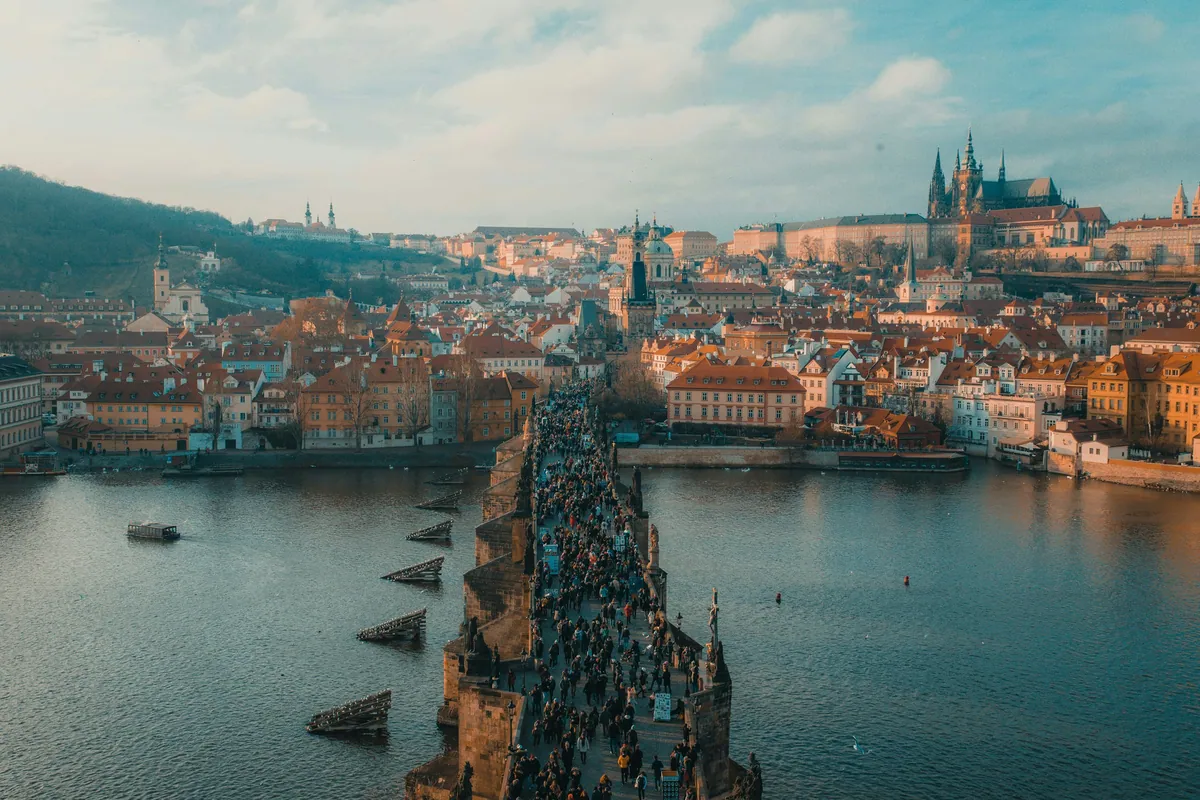
Prague is the fifth most visited city in Europe and anchors a country with 17 UNESCO World Heritage Sites, three of them transnational. Architectural heritage is central to what visitors see, from castles and châteaux spanning different historical epochs, including Karlštejn Castle, Český Krumlov, and the Lednice–Valtice Cultural Landscape, to a dozen cathedrals and fifteen churches raised to the rank of basilica, along with numerous monasteries. The earliest preserved stone buildings in Bohemia and Moravia date to the Christianization of the 9th and 10th centuries, with the oldest surviving churches built in the Romanesque style before Gothic architecture took hold in the 13th century; in the 14th century, Emperor Charles IV brought architects Matthias of Arras and Peter Parler to his court in Prague. Beyond the towns, areas such as Bohemian Paradise, the Bohemian Forest, and the Giant Mountains draw visitors away from the cities.
Geographically, the Czech Republic lies mostly between latitudes 48° and 51° N. Bohemia, to the west, is a basin drained by the Elbe and Vltava rivers and surrounded by mostly low mountains such as the Giant Mountains range of the Sudetes, home to the country's highest point, Sněžka, at 1,603 metres. Moravia in the east is hilly and drained mainly by the Morava River. Water from the country flows to three different seas: the North Sea, Baltic Sea, and Black Sea. The climate is temperate, sitting in the transition zone between oceanic and continental types, with warm summers and cold, cloudy, snowy winters; temperatures vary with elevation, decreasing at higher altitudes as precipitation increases, and the coldest month is usually January.
Czech cuisine emphasizes meat dishes built around pork, beef, and chicken, along with goose, duck, rabbit, and venison, while fish appears less often outside the fresh trout and carp traditionally served at Christmas. A popular menu staple is smažený vepřový řízek, a fried breaded pork fillet served with boiled potatoes, alongside local sausages, wurst, pâtés, and cured meats, and desserts built on whipped cream, chocolate, fruit pastries, and cakes such as buchty, koláče, and štrúdl. Czech beer brewing traces back more than a millennium, with the earliest known brewery dating to 993; the country has the highest beer consumption per capita in the world, and the pilsner style that inspired more than two-thirds of the beer produced worldwide today originated in Plzeň, where Pilsner Urquell is still brewed. The South Moravian region has its own long tradition of wine production, rounding out a food and drink culture as regionally distinct as the country's architecture.
- Czech Republic — Wikipedia, CC BY-SA 4.0
Text adapted from the linked articles under CC BY-SA 4.0; edited for length.
Trip Snapshot
Highlights
Suitable For
Czech Republic, in frame
A quick visual sense of the landscapes, stays, and atmosphere your itinerary can be built around.
Build a Czech Republic itinerary around your dates.
Share your travel month, group size, budget comfort, and must-do experiences. The Taro team will shape the right route before any payment conversation.