Why Cuba works
Cuba, officially the Republic of Cuba, is an island country in the Caribbean comprising its main island and 4,195 smaller islands, islets, and cays, sitting at the convergence of the Caribbean Sea, the Gulf of Mexico, and the Atlantic Ocean. It lies east of the Yucatán Peninsula, south of Florida and the Bahamas, west of Hispaniola, and north of Jamaica, and is the largest country in the Caribbean by area. The main island runs 1,250 kilometres long, mostly flat to rolling plains apart from the Sierra Maestra mountains in the southeast, whose highest point, Pico Turquino, reaches 1,974 metres, and Havana serves as the country's capital and largest city.
Cuba's earliest inhabitants arrived around 6,000 years ago from northern South America or Central America, followed roughly 1,700 years ago by the Arawakan-speaking ancestors of the Taíno, who brought pottery production and intensive agriculture and largely replaced the island's earlier population. Christopher Columbus reached Cuba on 27 October 1492 and claimed it for the Spanish crown, and the first Spanish settlement was founded at Baracoa in 1511 by Diego Velázquez de Cuéllar, followed by San Cristóbal de la Habana, established in 1519 at its present site and made the colonial capital in 1607. Taíno communities suffered severe population loss under Spanish colonial rule, driven largely by Eurasian infectious diseases against which they had no immunity, including a 1529 measles outbreak that killed two-thirds of the survivors of an earlier smallpox epidemic.
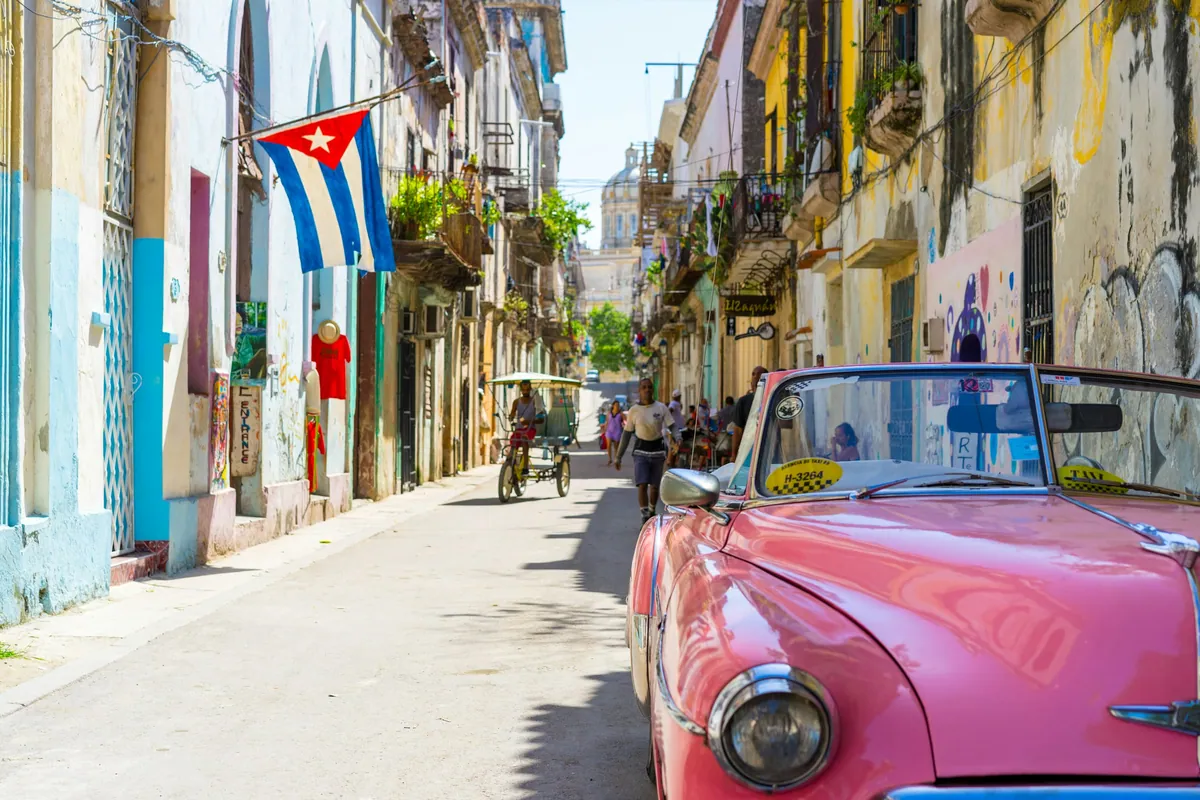
Cuban colonial architecture grew up around central churches, with residential courtyards and iron grilles a common feature, and Spanish Baroque style shaping religious buildings such as Havana's Basílica de San Francisco; the threat of piracy also drove the construction of large coastal fortifications. Havana, Camagüey, Cienfuegos, and Trinidad are all inscribed as UNESCO World Heritage Sites for their historic colonial-era architecture, spanning Baroque, Neoclassical, and eclectic styles, and further colonial towns including Santiago de Cuba, Matanzas, and Remedios preserve architecture from the same period. The main island is surrounded by four smaller archipelagos — the Colorados on the northwest coast, the Sabana-Camagüey to the north, the Jardines de la Reina to the south-central coast, and the Canarreos to the southwest — with Isla de la Juventud the largest of these outlying islands.
Lying entirely south of the Tropic of Cancer, Cuba has a tropical climate moderated by year-round northeasterly trade winds and warmed further by the Caribbean Current, making it warmer than Hong Kong despite sitting at a similar latitude. The island has a drier season from November to April and a rainier one from May to October, with average temperatures around 21°C in January and 27°C in July, and its position at the entrance to the Gulf of Mexico, combined with the warm Caribbean Sea, makes it prone to hurricanes, most common in September and October.
Cuban cuisine fuses Spanish and Caribbean traditions, sharing many spices and techniques with Spanish cooking alongside Caribbean influence in flavour. A typical meal, served all at once rather than in courses, might include plantains, black beans and rice — known as moros y cristianos — ropa vieja, Cuban bread, and pork with onions, with garlic, cumin, oregano, and bay leaves as the dominant spices; food rationing, a fixture of Cuban life for decades, has shaped how readily these staples are available. The Taíno practice of smoking tobacco, first documented by the Spanish on the island, later spread worldwide through the same era of contact that brought European settlement to Cuba.
- Cuba — Wikipedia, CC BY-SA 4.0
Text adapted from the linked articles under CC BY-SA 4.0; edited for length.
Trip Snapshot
Highlights
Suitable For
Cuba, in frame
A quick visual sense of the landscapes, stays, and atmosphere your itinerary can be built around.
Build a Cuba itinerary around your dates.
Share your travel month, group size, budget comfort, and must-do experiences. The Taro team will shape the right route before any payment conversation.