Why China works
China, officially the People's Republic of China, is a country in East Asia divided into 33 province-level divisions, including two special administrative regions, with Beijing as its capital and Shanghai as its most populous city by urban area. Covering 9.6 million square kilometres, China is the world's third-largest country by area and, with a population exceeding 1.4 billion, the world's second-most populous after India. Its geography ranges from a dry, mountainous west across the Himalayas and Tian Shan to wide river valleys and mountains in the east, including the Central Plain long settled around China's two longest rivers, the Yangtze and the Yellow River, both of which rise on the Tibetan Plateau.
After 2000 BCE, a Bronze Age culture known archaeologically as the Erlitou culture emerged in the Central Plain, sometimes linked to the traditionally recognised first dynasty, the Xia, though no written records confirm the connection. The Shang dynasty is thought to have succeeded the Xia around 1600 BCE, and its late period is attested through oracle bone inscriptions, the earliest known form of Chinese writing and ancestor of today's Chinese characters. The Shang were overthrown by the Zhou around 1046 BCE; centralised Zhou authority collapsed in 771 BCE, and the ensuing Warring States period produced the philosophical schools of Confucianism, Daoism, Mohism, and Legalism that continue to shape Chinese thought.
Traditional Chinese architecture is built predominantly in wood, with important buildings topped by ornate, hipped ceramic-tile roofs and complexes typically arranged around cardinal directions and large courtyards, their layout often shaped by the principles of feng shui. Pagodas, tall multi-story religious towers introduced alongside Buddhism, are among China's oldest surviving buildings, while Western architectural styles arrived in the nineteenth century and, since the reform era, a boom in skyscrapers and office towers has increasingly supplanted traditional building in Chinese cities. China's largest island is Taiwan, and the largest island under PRC administration is Hainan, while Poyang Lake is the largest of the country's many freshwater lakes.
Geographically, China's western mountain ranges include the Turpan Depression, among the lowest points on land, and the Tibetan Plateau, while Mount Everest, the world's highest point at 8,848 metres, sits on China's border with Nepal. China's coastline runs along the Bohai, Yellow, East China, and South China Seas, and the country's climate is shaped by dry seasons alternating with wet monsoons, producing pronounced seasonal temperature swings across its territory.
Chinese meals typically pair a grain with meat or vegetable dishes: wheat, in the form of steamed buns, dumplings, noodles, and pancakes, dominates in the north alongside maize and millet, while rice, steamed or as congee, rice noodles, or rice cakes, dominates in the south. Pork, chicken, fish, and duck are the most common meats, soybeans appear widely as tofu and soy sauce, and stir-frying in a wok is the most common cooking method alongside steaming, deep-frying, and hot pot, where food is cooked in simmering broth at the table. Meals are typically shared rather than plated individually, chopsticks are the standard utensil, hot tea usually accompanies food in place of water, and rice wine or the distilled liquor baijiu commonly appears at the table as well, and people generally eat three meals a day, with a simpler breakfast giving way to a more elaborate dinner.
- China — Wikipedia, CC BY-SA 4.0
Text adapted from the linked articles under CC BY-SA 4.0; edited for length.
Trip Snapshot
Highlights
Suitable For
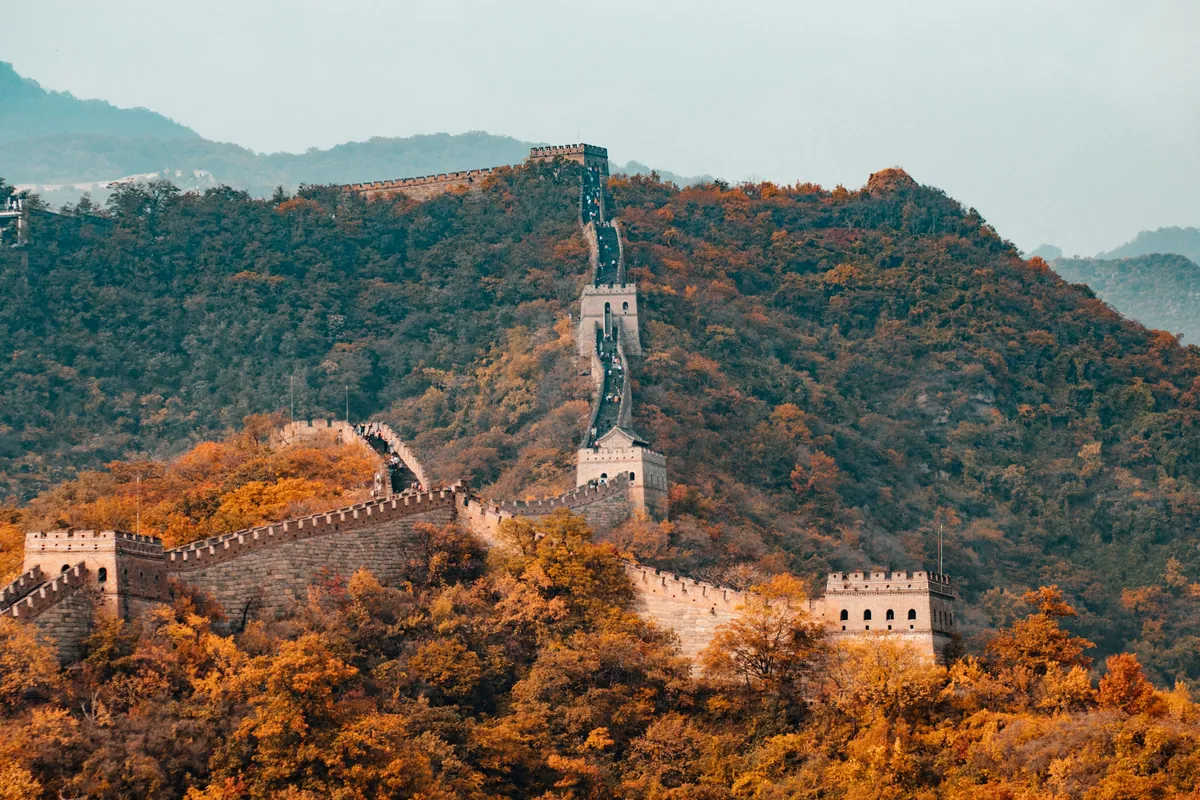
China, in frame
A quick visual sense of the landscapes, stays, and atmosphere your itinerary can be built around.
Build a China itinerary around your dates.
Share your travel month, group size, budget comfort, and must-do experiences. The Taro team will shape the right route before any payment conversation.