Why Brazil works
Brazil, officially the Federative Republic of Brazil, is the largest country in South America and the world's fifth-largest by area, occupying nearly half the continent's land. It shares a border with every South American country except Ecuador and Chile, bounded by Uruguay to the south, Argentina and Paraguay to the southwest, Bolivia and Peru to the west, Colombia to the northwest, and Venezuela, Guyana, Suriname, and French Guiana to the north. Brazil is a federation of 26 states and a Federal District, home to the capital, Brasília, while São Paulo and Rio de Janeiro are its most populous cities; it is also the only country in the world through which both the equator and the Tropic of Capricorn pass.
Some of the earliest human remains found in the Americas, known as Luzia Woman, were discovered in Minas Gerais and point to habitation going back at least 11,000 years, and pottery excavated near Santarém in the Amazon basin, radiocarbon dated to about 8,000 years ago, is among the oldest found anywhere in the Western Hemisphere. Portuguese claims began after the 1494 Treaty of Tordesillas, formalised when Pedro Álvares Cabral's fleet arrived on 22 April 1500; colonization effectively started in 1534, when King John III of Portugal divided the territory into fifteen private captaincies, later restructured in 1549 into a centralized colony governed from Salvador. By the mid-sixteenth century, cane sugar had become Brazil's leading export.
Brazil is home to roughly 60% of the Amazon rainforest and is considered to have the greatest biodiversity of any country on the planet, containing more than 70% of all catalogued animal and plant species worldwide; it holds the most known plant species of any country, at around 55,000, along with the most freshwater fish species and more than 689 recorded mammal species. Beyond the Amazon, the country's ecosystems include the Atlantic Forest and the Cerrado, both major centres of biodiversity in their own right, and the temperate Araucaria moist forests farther south. Brazil ranks third in the world for bird species, with 1,832 recorded, and second for reptile species, with 744, and it is second only to Indonesia in the number of species found nowhere else on Earth.
Brazil's climate is mostly tropical but spans six major Köppen subtypes across its territory, from desert and semiarid conditions to equatorial, tropical, oceanic, and subtropical zones. That range produces environments as different as the equatorial rainforest of the north, the semiarid interior of the northeast, tropical savanna across the centre, and temperate coniferous forest in the south. As of 2020, forest still covered around 59% of Brazil's land area, though that figure has declined from nearly 589 million hectares in 1990 to under 497 million hectares.
Brazilian food varies sharply by region, shaped by the country's mix of Indigenous, European, and African influences, though feijoada, a black bean and pork stew, is generally considered the national dish, alongside churrasco, barbecued meat often served rodízio-style. Regional dishes include moqueca, vatapá, and acarajé, the last with roots in African cuisine, while a typical everyday meal centres on rice and beans with beef, salad, and farofa, cassava flour toasted and mixed through the plate. Coffee is the national beverage, and cachaça, distilled from sugar cane, is Brazil's native liquor and the base of its national cocktail, the caipirinha. Popular snacks such as pastel, a fried pastry, and pão de queijo, cheese bread made with cassava flour, round out a food culture defined as much by regional variety as by any single dish.
- Brazil — Wikipedia, CC BY-SA 4.0
Text adapted from the linked articles under CC BY-SA 4.0; edited for length.
Trip Snapshot
Highlights
Suitable For
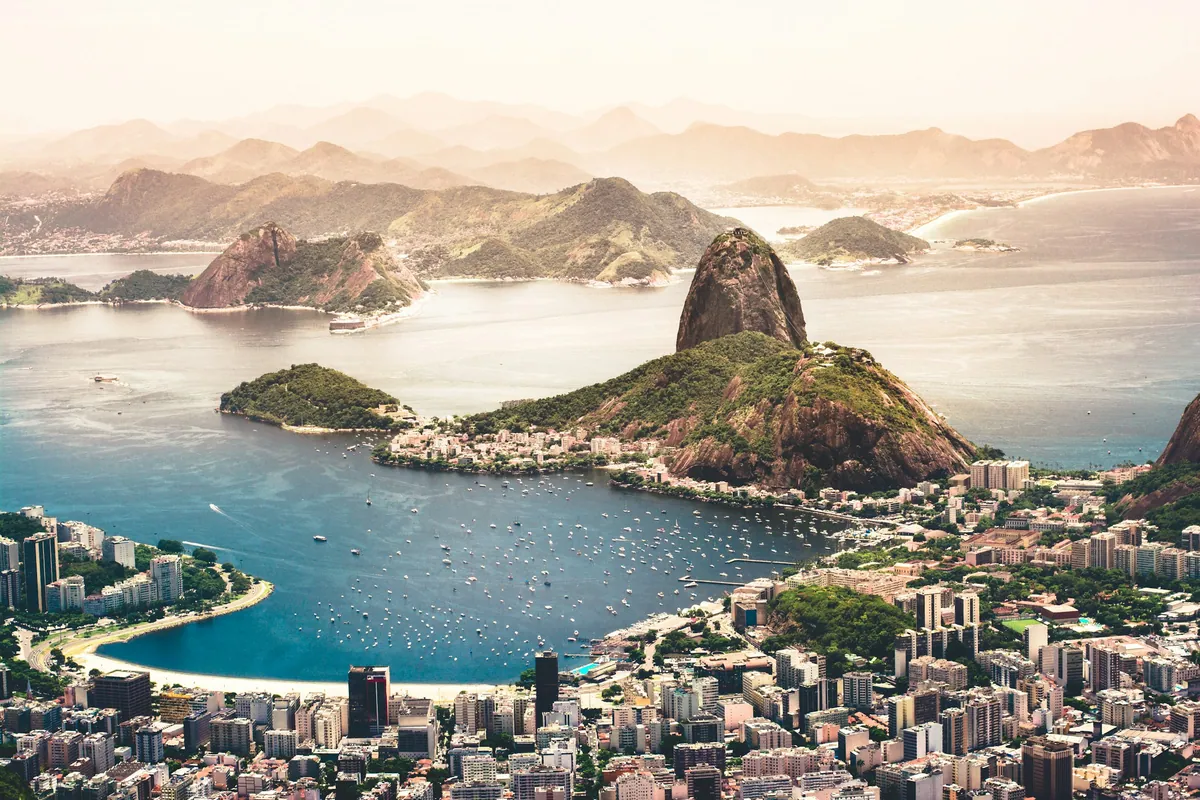
Brazil, in frame
A quick visual sense of the landscapes, stays, and atmosphere your itinerary can be built around.
Build a Brazil itinerary around your dates.
Share your travel month, group size, budget comfort, and must-do experiences. The Taro team will shape the right route before any payment conversation.