Why Bali works
Bali is an Indonesian island and province, the westernmost of the Lesser Sunda Islands, lying east of Java and west of Lombok and separated from Java by the narrow Bali Strait. The province also includes smaller offshore islands, notably Nusa Penida, Nusa Lembongan, and Nusa Ceningan to the southeast. Denpasar is the provincial capital and the most populous city in the Lesser Sunda Islands, while the upland town of Ubud, within Greater Denpasar, is regarded as Bali's cultural centre.
Austronesian peoples migrating from Taiwan through Maritime Southeast Asia settled Bali around 2000 BC, and stone tools from that period have been found near the village of Cekik in the island's west. Ancient Bali was home to nine Hindu sects, each honouring its own deity, and by the tenth century inscriptions record an independent Balinese kingdom with its own dialect, influenced by Sanskrit and Pali, where Buddhism and Shaivism were practised side by side. Balinese Hinduism today, followed by about 86% of the island's population, developed as a synthesis of these older local beliefs with Hindu traditions brought from mainland Southeast Asia and South Asia.
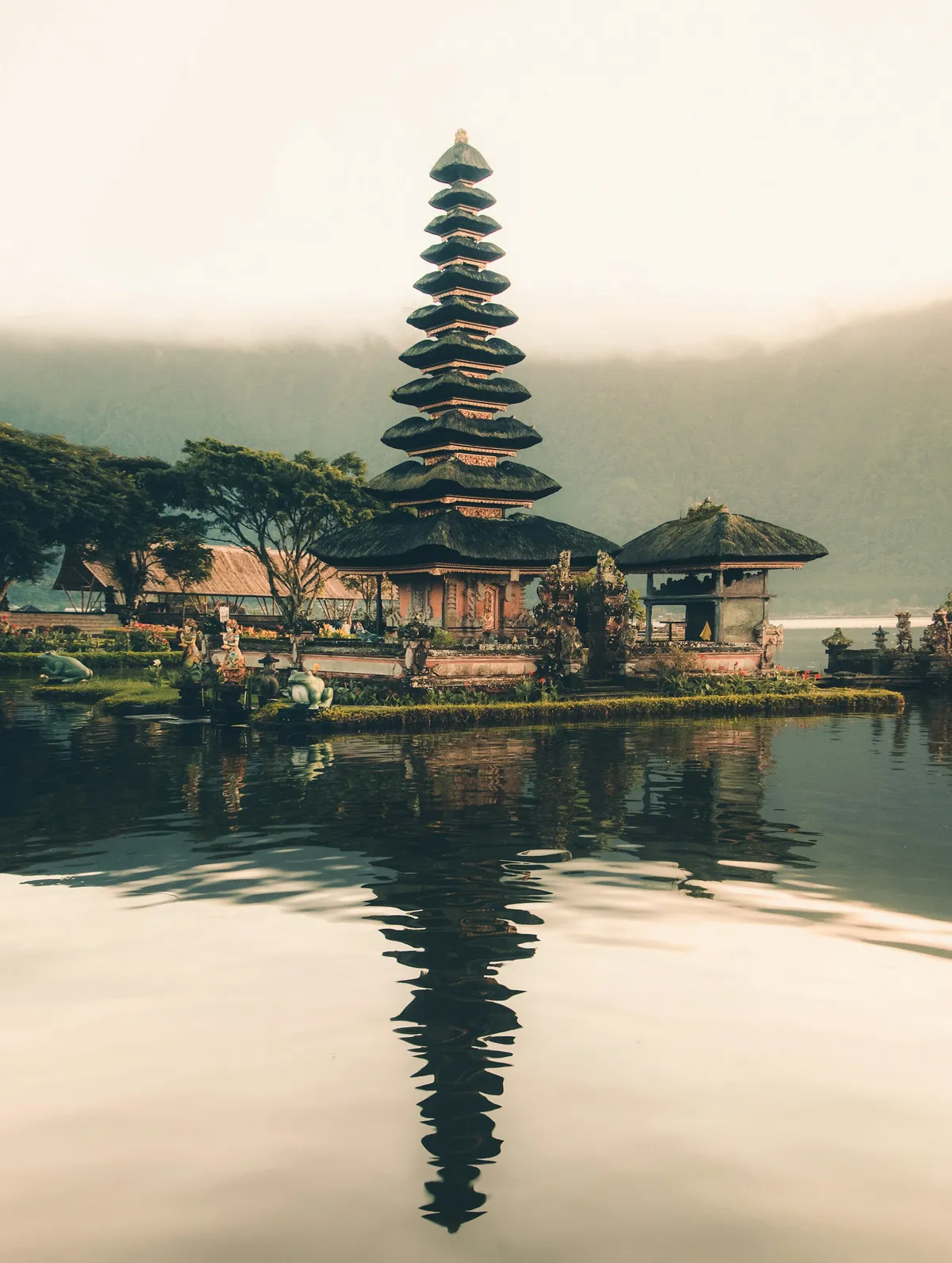
That religious life shapes Bali's built environment: Balinese architecture is organised around kaja and kelod, the directions toward the island's largest mountain, Gunung Agung, and toward the sea, believed respectively to be the domain of gods and ancestors and of demons. Temples are laid out with their most sacred spaces closest to the mountain, an inner courtyard reserved for wali rituals performed for the gods alone, and an outer courtyard for bebali ceremonies meant for both gods and people. In June 2012, Subak, the traditional irrigation system for the rice paddies of Jatiluwih in central Bali, was listed as a UNESCO World Heritage Site, and the island's calendar is punctuated by festivals such as Nyepi, the Hindu New Year marked by a day of island-wide silence preceded by the burning of Ogoh-ogoh monster effigies to drive away evil spirits.
Bali's central mountains include several peaks above 2,000 metres and active volcanoes such as Mount Batur, with Mount Agung — known as the "mother mountain" — the island's highest point at 3,031 metres; the volcano erupted in late 2017, an event serious enough that the island's airport temporarily closed. That same volcanic geology has made Bali's soil exceptionally fertile, and its mountain ranges draw the rainfall that supports intensive agriculture, including the Arabica coffee grown around Kintamani near Mount Batur, much of it farmed under the traditional Subak Abian system. Sitting only about 8 degrees south of the equator, the island has a fairly even climate year-round, with average temperatures around 30°C and a west monsoon bringing heavier rain from roughly October to April, especially between December and March.
Tourism has long been Bali's leading source of GDP, though agriculture remains its biggest employer, alongside fishing and a strong handicraft tradition in which individual villages often specialise in a single product such as woodcarving or wind chimes. Tourism has also reshaped the island's performing arts: since the 1930s, sacred dances such as the barong have been staged both in their original ritual context and, separately, for paying visitors, with some villages keeping a distinct mask reserved only for non-ritual performance. That tourism economy, concentrated heavily around Denpasar and Ubud, has grown markedly since the 1980s, making Bali Indonesia's principal tourist destination even as its rice terraces, temple festivals, and religious calendar continue to run on their own long-standing rhythm.
- Bali — Wikipedia, CC BY-SA 4.0
Text adapted from the linked articles under CC BY-SA 4.0; edited for length.
Trip Snapshot
Suitable For
Bali, in frame
A quick visual sense of the landscapes, stays, and atmosphere your itinerary can be built around.
Bali questions, answered
When is the best time to visit Bali?
April to October
What is the weather like in Bali?
Tropical, 27-30°C
Do I need a visa to travel to Indonesia?
Visa on arrival for Indians (30 days). Visa rules change without notice — confirm current requirements with the destination's embassy or consulate before you book.
What currency is used in Indonesia?
Indonesian Rupiah (IDR)
What languages are spoken in Indonesia?
Bahasa Indonesia, English in tourist areas
Build a Bali itinerary around your dates.
Share your travel month, group size, budget comfort, and must-do experiences. The Taro team will shape the right route before any payment conversation.