Why Azerbaijan works
Azerbaijan, officially the Republic of Azerbaijan, is a transcontinental, landlocked country at the boundary of Western Asia and Eastern Europe, part of the South Caucasus region. It is bordered by the Caspian Sea to the east, Russia's republic of Dagestan to the north, Georgia to the northwest, Turkey and Armenia to the west, and Iran to the south, with Baku as its capital and largest city. The country's terrain is unusually varied for its size, containing nine of the world's eleven recognised climate zones, and its flora, with more than 4,500 species of higher plants, is richer than that of its South Caucasus neighbours — around 66% of all plant species found across the wider Caucasus occur here.
The earliest evidence of human settlement in the region dates to the late Stone Age, associated with the Guruchay culture at Azykh Cave, and by the ninth century BC the Scythians had settled the territory, followed by the Iranian Medes, whose empire was absorbed into the Achaemenid Empire around 550 BC, bringing the spread of Zoroastrianism to the area. Oil has shaped the region for far longer than the modern era: the Arab historian and traveller Ahmad Al-Baladhuri wrote about the oil economy of the Absheron Peninsula in antiquity. The country's more recent history runs from the Sasanid through the Safavid periods and into the modern era, culminating in independence and, since 1993, the continued rule of the Aliyev family.
Baku's Walled City preserves architectural treasures including the Maiden Tower and the Palace of the Shirvanshahs, built under heavy Persian influence in a style that blends East and West. Several further sites sit on UNESCO's World Heritage tentative list, among them the Ateshgah of Baku, the Momine Khatun Mausoleum, and the Palace of Shaki Khans, while more recent landmarks such as the Heydar Aliyev Cultural Center and the Flame Towers represent a modern architectural push toward the country's own artistic style. In winter, the Shahdag Mountain Resort offers skiing, part of a tourism industry that is recovering after being damaged by the fall of the Soviet Union and the First Nagorno-Karabakh War in the 1990s.
Geographically, more than half of Azerbaijan consists of mountain ridges, highlands, and plateaus, with elevations ranging from about 28 metres below sea level at the Caspian shoreline to 4,466 metres at Bazardüzü peak; the rest of the country is plains and lowlands. The Greater Caucasus shields much of the country from cold air moving down from the north, helping produce a subtropical climate across many of its foothills and plains, while the country as a whole has recorded temperatures from an absolute minimum of −33°C to an absolute maximum of 46°C, both around the Julfa and Ordubad area. Wildlife recorded in the country includes 106 species of mammals, 363 species of birds, and 97 species of fish, along with the Karabakh horse, Azerbaijan's national animal, an ancient but now endangered mountain-steppe breed known for its temperament and speed.
Azerbaijani cuisine draws on an abundance of seasonal vegetables and fresh herbs — mint, cilantro, dill, tarragon, and others — alongside fish from the Caspian Sea and meat, mainly mutton and beef. Saffron-rice plov is considered the country's flagship dish, and black tea, traditionally served in a pear-shaped armudu glass, is the national drink. Other traditional dishes include bozbash, a lamb soup with regional variations; qutab, a fried turnover filled with greens or minced meat; and dushbara, dumplings filled with ground meat and spices.
- Azerbaijan — Wikipedia, CC BY-SA 4.0
Text adapted from the linked articles under CC BY-SA 4.0; edited for length.
Trip Snapshot
Highlights
Suitable For
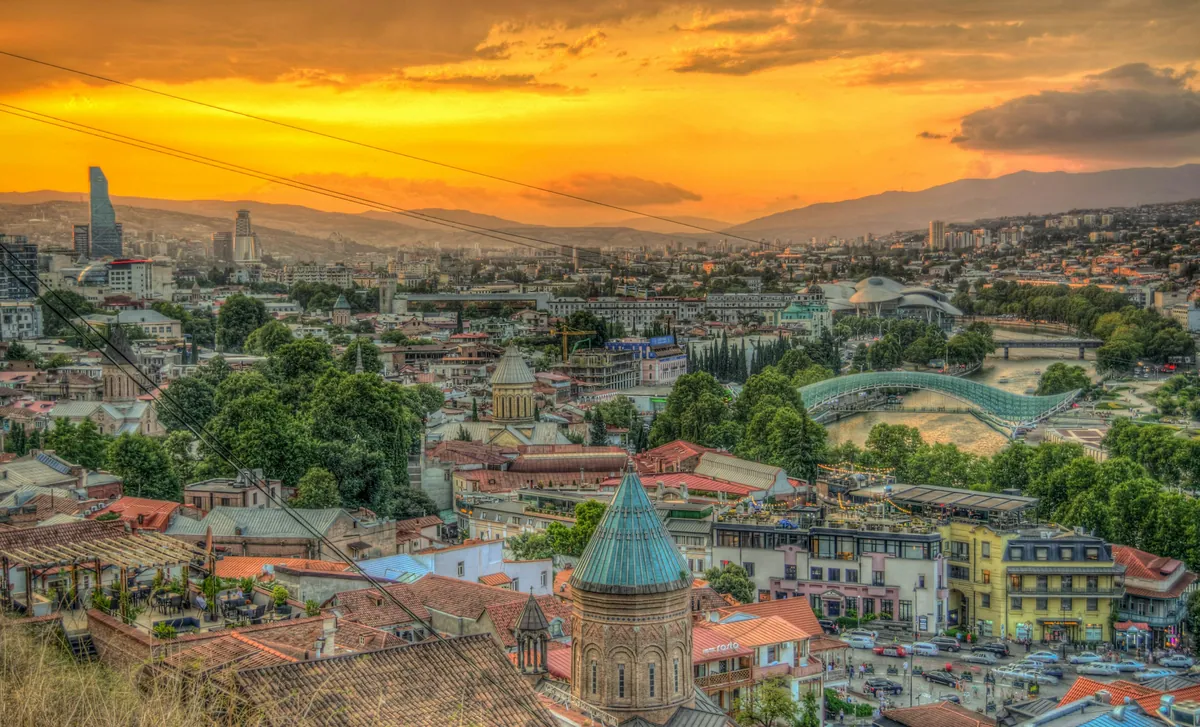
Azerbaijan, in frame
A quick visual sense of the landscapes, stays, and atmosphere your itinerary can be built around.
Build a Azerbaijan itinerary around your dates.
Share your travel month, group size, budget comfort, and must-do experiences. The Taro team will shape the right route before any payment conversation.