Why Ayurveda Kerala Retreat works
Kerala is a state on the Malabar Coast of southern India, formed on 1 November 1956 when the States Reorganisation Act unified the country's Malayalam-speaking regions. It is a narrow strip of coastal plains, between 11 and 121 kilometres wide, wedged between the Western Ghats and the Laccadive Sea, bordered by Karnataka to the northeast and Tamil Nadu to the east, with Thiruvananthapuram as its capital and the Kochi metropolitan area as its most populous region. More than three-quarters of Kerala's land lay under thick forest as recently as the eighteenth century, and the Western Ghats still hold much of the state's biodiversity today, including over a quarter of India's plant species.
Kerala has been a spice exporter since at least 3000 BCE according to Sumerian records, long known as the "Garden of Spices," and its spices drew ancient Babylonians, Assyrians, and Egyptians to the Malabar Coast, followed by Arab and Phoenician traders. In antiquity the region was ruled by the Cheras, one of four kingdoms in southern India in the time of Emperor Ashoka, and Malayalam is thought to have developed into a distinct language from a west-coast dialect of Tamil sometime between the ninth and thirteenth centuries. A catastrophic flood in 1341 CE reshaped Kerala's coastline, and in doing so created a natural harbour that supported the region's continuing spice trade.
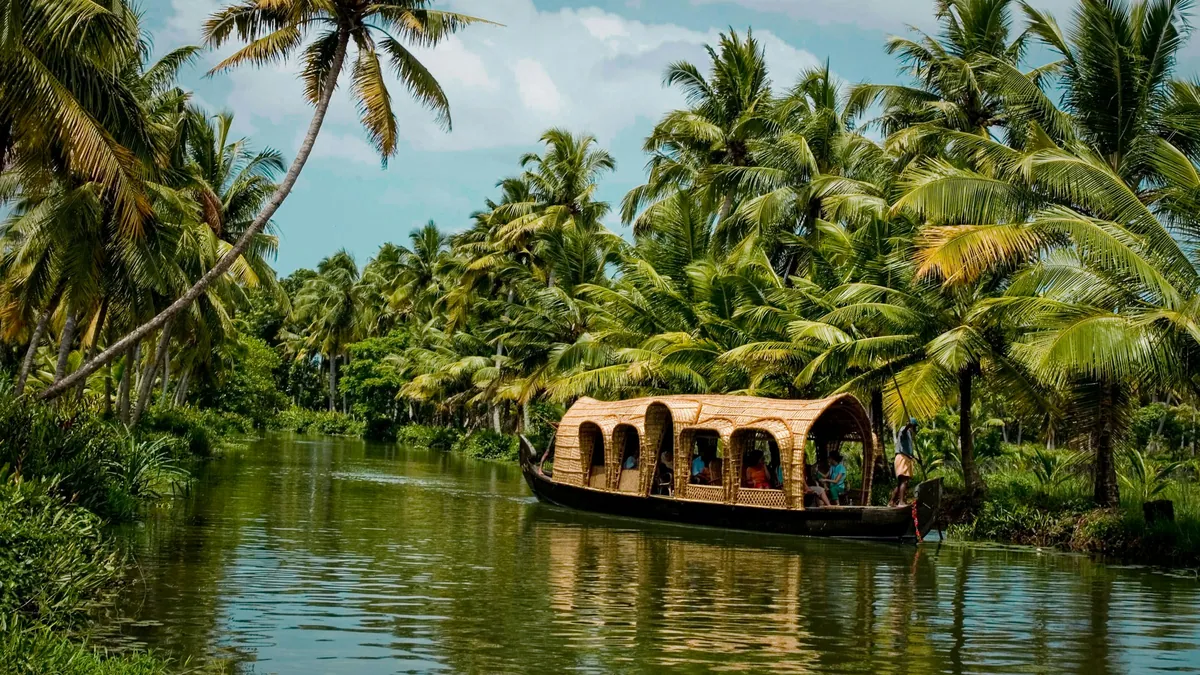
Kerala's tourism draws on its beaches, backwaters, lakes, mountain ranges, waterfalls, ancient ports, palaces, religious institutions, and wildlife sanctuaries, with Kochi drawing the largest share of the state's domestic and international visitors. Temple festivals are part of the visible culture across the state — more than 10,000 are held every year — often marked by the hoisting and lowering of a holy flag and processions built around richly decorated elephants; Thrissur Pooram, known for its elephants, fireworks, and large crowds, is among the best known. Kerala's wetlands include four sites listed under the Ramsar Convention, among them Lake Sasthamkotta and the Vembanad-Kol wetlands, and the state's cultural profile has drawn international recognition, including National Geographic Traveller naming it one of the "ten paradises of the world" in 2012.
Geographically, Kerala divides into three bands: the cool, rugged eastern highlands along the Western Ghats, rolling central midlands, and the western coastal lowlands. Its climate is wet and maritime tropical, with 120 to 140 rainy days a year: roughly 65% of the state's rainfall arrives with the southwest monsoon between June and August, when the Arabian Sea branch of the monsoon reaches Kerala before any other Indian state, and the rest comes with the northeast monsoon later in the year. Rainfall varies sharply within the state, from around 1,250 millimetres in the drier lowlands to more than 5,000 millimetres in the mountains of Idukki district.
Kerala is also closely associated with Ayurveda, a traditional system of medicine with roots in the Indian subcontinent that remains widely practised across India, and whose therapies historically include herbal preparations, special diets, massage, and yoga. On the table, rice underpins most meals, from breakfast dishes such as idli, dosa, puttu, and appam to Sadhya, a vegetarian meal served on a banana leaf and finished with payasam, alongside coastal specialities such as karimeen and prawns. Kerala's culture more broadly is a composite of Aryan, Dravidian, Arab, and European influences built up over centuries of trade and contact, expressed today through Malayalam, its own solar sidereal calendar dating to 825 CE, and a shared calendar of festivals across its Hindu, Muslim, and Christian communities.
Trip Snapshot
Highlights
Suitable For
Ayurveda Kerala Retreat, in frame
A quick visual sense of the landscapes, stays, and atmosphere your itinerary can be built around.
Build a Ayurveda Kerala Retreat itinerary around your dates.
Share your travel month, group size, budget comfort, and must-do experiences. The Taro team will shape the right route before any payment conversation.