Why Austria works
Austria, formally the Republic of Austria, is a landlocked country in Central Europe lying in the Eastern Alps, organized as a federation of nine states with Vienna as its capital and most populous city and state. It borders Germany to the northwest, the Czech Republic to the north, Slovakia to the northeast, Hungary to the east, Slovenia and Italy to the south, and Switzerland and Liechtenstein to the west, covering an area of 83,879 square kilometres. The country is largely mountainous: the Eastern Alps alone make up 62% of Austria's total area, and only about a quarter of the country's land is genuinely low-lying, with the Alps of the west giving way to lowland plains toward the east, near the Pannonian basin.
Austria's territory has passed through a long succession of powers: after the fall of the Roman Empire it was held in turn by the Germanic Rugii, the statesman Odoacer, and the Ostrogoths, before Charlemagne conquered the area in 788 and introduced Christianity as part of Eastern Francia. The earliest written record of the name "Austria" dates to 996, referring to the March held by the House of Babenberg, and in 1156 the Privilegium Minus raised Austria to the status of a duchy. Vienna's rise as a European cultural centre began in the early sixteenth century, and by the eighteenth and nineteenth centuries the patronage of the ruling Habsburgs had made it the European capital of classical music, a status that shaped much of the city's architecture and public life.
That musical heritage is Austria's best-known cultural export: the country was the birthplace of composers including Joseph Haydn, Franz Schubert, Anton Bruckner, and both Johann Strauss Sr. and Jr., along with the Second Viennese School figures Arnold Schoenberg, Anton Webern, and Alban Berg, while Wolfgang Amadeus Mozart, born in Salzburg, spent much of his career in Vienna. Given its Alpine terrain, Austria is also a major centre for winter sport — alpine skiing is economically important as well as popular, and Austrian skiers such as Franz Klammer, Hermann Maier, and Toni Sailer are counted among the sport's greatest competitors, while bobsleigh, luge, and skeleton events run on a permanent track at Igls, and Innsbruck has twice hosted the Winter Olympics, in 1964 and 1976, plus the first Winter Youth Olympics in 2012.
Austria's climate lies mostly in the cool, temperate zone, dominated by humid westerly winds, with an alpine climate prevailing across the nearly three-quarters of the country covered by the Alps. In the east, across the Pannonian Plain and along the Danube valley, the climate takes on more continental features, with less rainfall than the alpine areas. Winters are cold, typically between −10°C and 0°C, while summer temperatures can climb into the mid-20s, with a recorded high of 40.5°C in August 2013; higher altitudes stay noticeably cooler than the valleys even in summer.
Austrian cuisine descends from the Habsburg imperial court kitchen, the Hofküche, and is known for its careful preparation of beef and pork alongside a wide range of vegetable dishes, plus a strong Mehlspeisen, or pastry, tradition. That tradition produced the Sachertorte, Krapfen doughnuts filled with apricot jam or custard, and varieties of strudel including Apfelstrudel and the cheese-curd Topfenstrudel, alongside the well-known Wiener Schnitzel. Because of its history at the centre of a multi-ethnic empire, Austrian cooking has also absorbed Hungarian, Czech, Polish, Jewish, Italian, Balkan, and French influences, making it one of the most multicultural and transcultural cuisines in Europe.
- Austria — Wikipedia, CC BY-SA 4.0
Text adapted from the linked articles under CC BY-SA 4.0; edited for length.
Trip Snapshot
Highlights
Suitable For
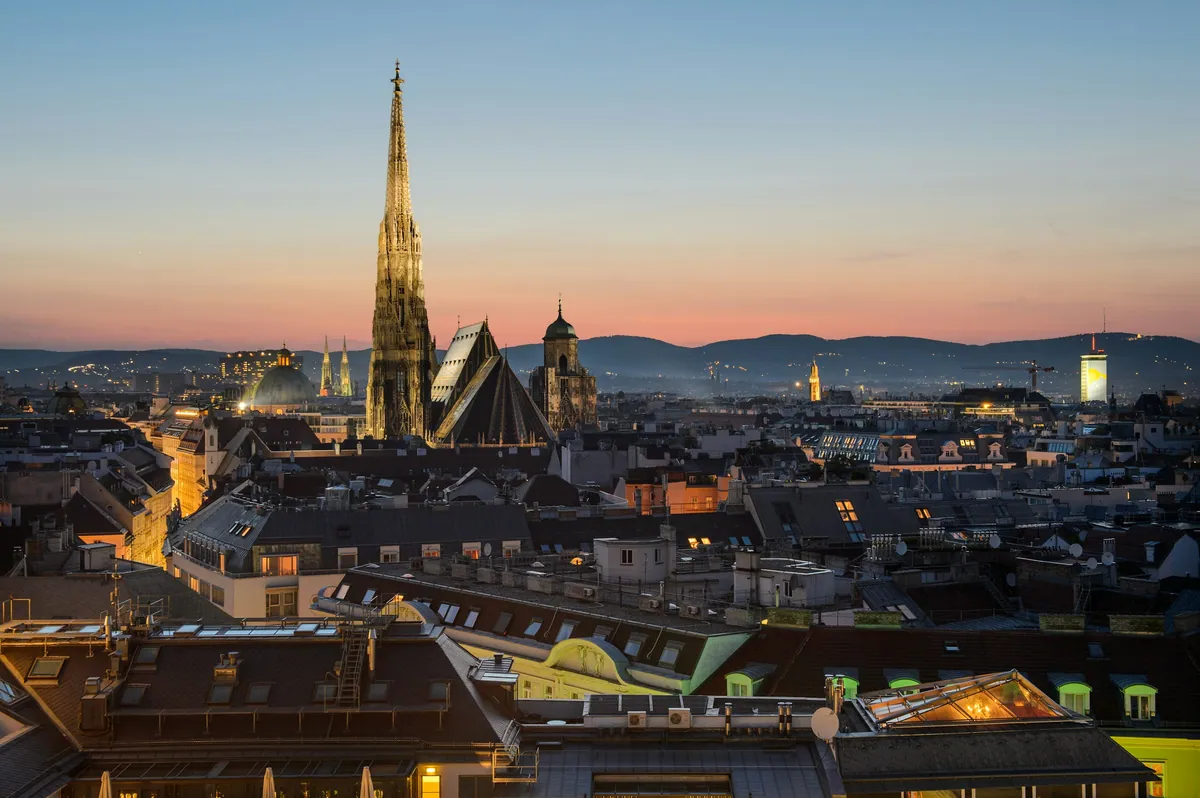
Austria, in frame
A quick visual sense of the landscapes, stays, and atmosphere your itinerary can be built around.
Build a Austria itinerary around your dates.
Share your travel month, group size, budget comfort, and must-do experiences. The Taro team will shape the right route before any payment conversation.