Why Argentina works
Argentina, officially the Argentine Republic, sits in the far south of South America, sharing the bulk of the Southern Cone with Chile to the west across the Andes, and bordered by Bolivia and Paraguay to the north, Brazil to the northeast, and Uruguay and the South Atlantic to the east. It is the second-largest country in South America after Brazil and the eighth-largest in the world, a federal republic of twenty-three provinces plus the autonomous capital city, Buenos Aires. Its geography spans extremes: Aconcagua, in Mendoza province, is the highest point in both the Southern and Western Hemispheres at 6,959 metres, while Laguna del Carbón, in Santa Cruz province, sits 105 metres below sea level as the lowest point in the same hemispheres.
Human presence in the region reaches back roughly 21,000 years; the Cueva de las Manos in Santa Cruz Province preserves stencilled handprints and hunting scenes created by early hunter-gatherer communities between 7,300 BC and 700 AD. Argentina's modern political history begins with the May Revolution of 1810, when the viceroy Baltasar Hidalgo de Cisneros was replaced by the First Junta, a locally formed government in Buenos Aires, setting off the war that would separate Argentina from Spanish rule. What followed was a long and often turbulent process of nation-building, through civil wars, the rise of a modern state, the Peronist era, periods of military rule, and an eventual return to democracy.
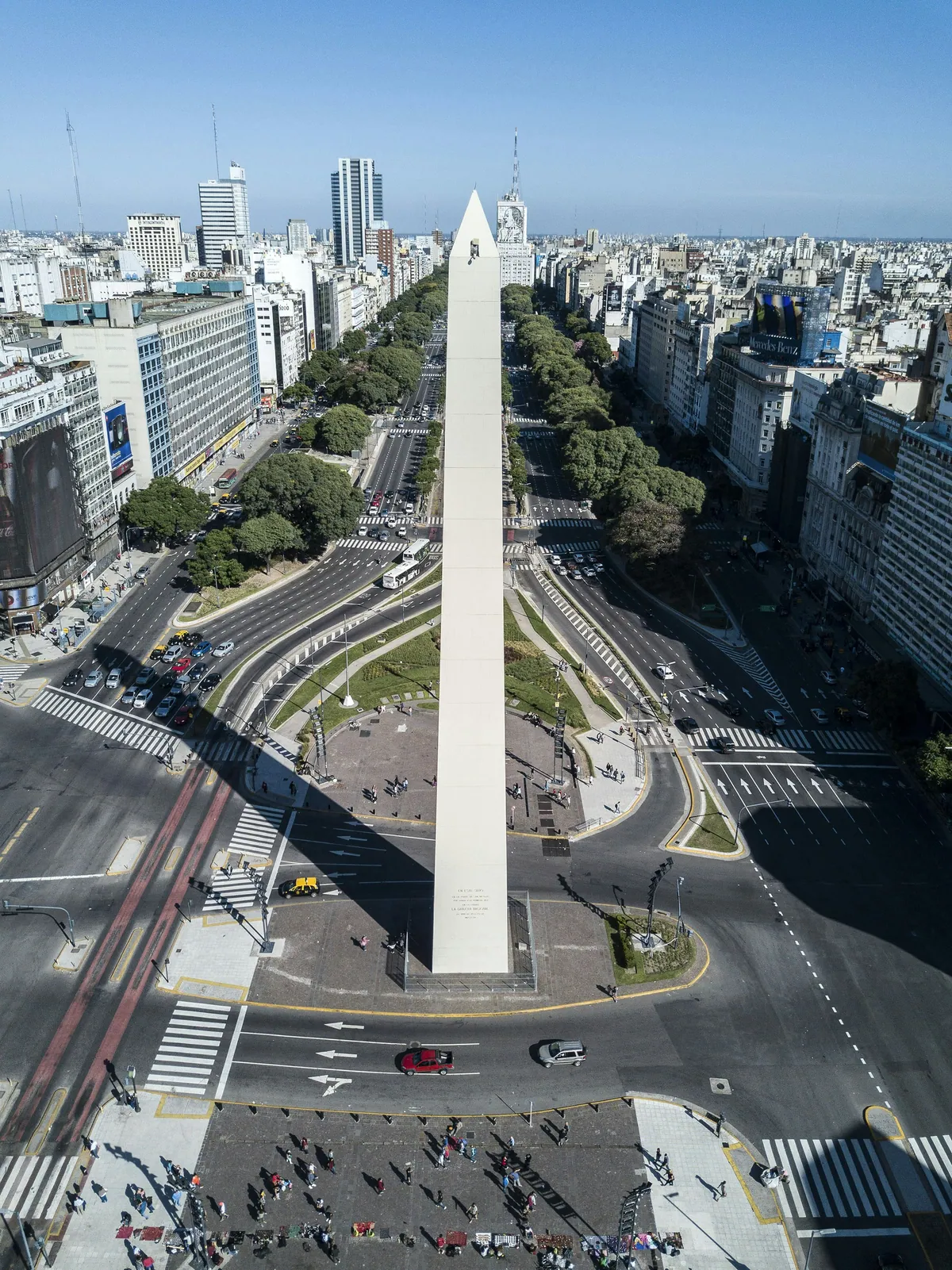
Buenos Aires, the capital, is the country's most visited city and the most visited in South America, and the country counts thirty National Parks, several of them UNESCO World Heritage Sites. The landscape itself is much of the draw: the Pampas' temperate plains give way south to Patagonia's cold, sub-Antarctic terrain, with Los Glaciares National Park, in Santa Cruz province, containing Argentina's westernmost point among its glacial scenery. Argentina is also one of the most biodiverse countries in the world, spanning fifteen continental zones, two marine zones, and part of the Antarctic region, with catalogued totals that include more than 9,000 vascular plant species and over 1,000 bird species.
Argentina's climate ranges from subtropical in the north to polar in the far south, encompassing four broad types — warm humid subtropical, moderate humid subtropical, arid, and cold — shaped by the country's long stretch of latitude, altitude, and terrain. Average annual precipitation swings just as widely, from around 150 millimetres in the driest parts of Patagonia to more than 2,000 millimetres in the westernmost Patagonian Andes and the northeast of the country, while mean annual temperatures range from about 5°C in the far south to 25°C in the north. The Pampero winds sweep the flat plains of Patagonia and the Pampas, and the Sudestada, a wind pattern off the Atlantic, typically moderates cold snaps but can bring heavy rain and rough seas.
Argentine food and drink draw on both European and Indigenous and Criollo traditions: empanadas, locro — a stew of corn, beans, meat, bacon, onion, and gourd — and mate sit alongside dishes with roots in continental European cooking. The country has the highest red meat consumption in the world, traditionally prepared as asado, the Argentine barbecue, often including chorizo and other cuts alongside the main meat. Desserts run to facturas, Viennese-style pastries, and alfajores, shortbread cookies filled with dulce de leche, while Argentine wine — regarded as among the finest in the world — remains central to the table, with Malbec, Torrontés, and Cabernet Sauvignon among its most sought-after varieties.
- Argentina — Wikipedia, CC BY-SA 4.0
Text adapted from the linked articles under CC BY-SA 4.0; edited for length.
Trip Snapshot
Highlights
Suitable For
Argentina, in frame
A quick visual sense of the landscapes, stays, and atmosphere your itinerary can be built around.
Build a Argentina itinerary around your dates.
Share your travel month, group size, budget comfort, and must-do experiences. The Taro team will shape the right route before any payment conversation.